Wire Size Calculator (Wire Gauge)
Enter the circuit, current and length to get the smallest wire size that meets your voltage-drop limit.
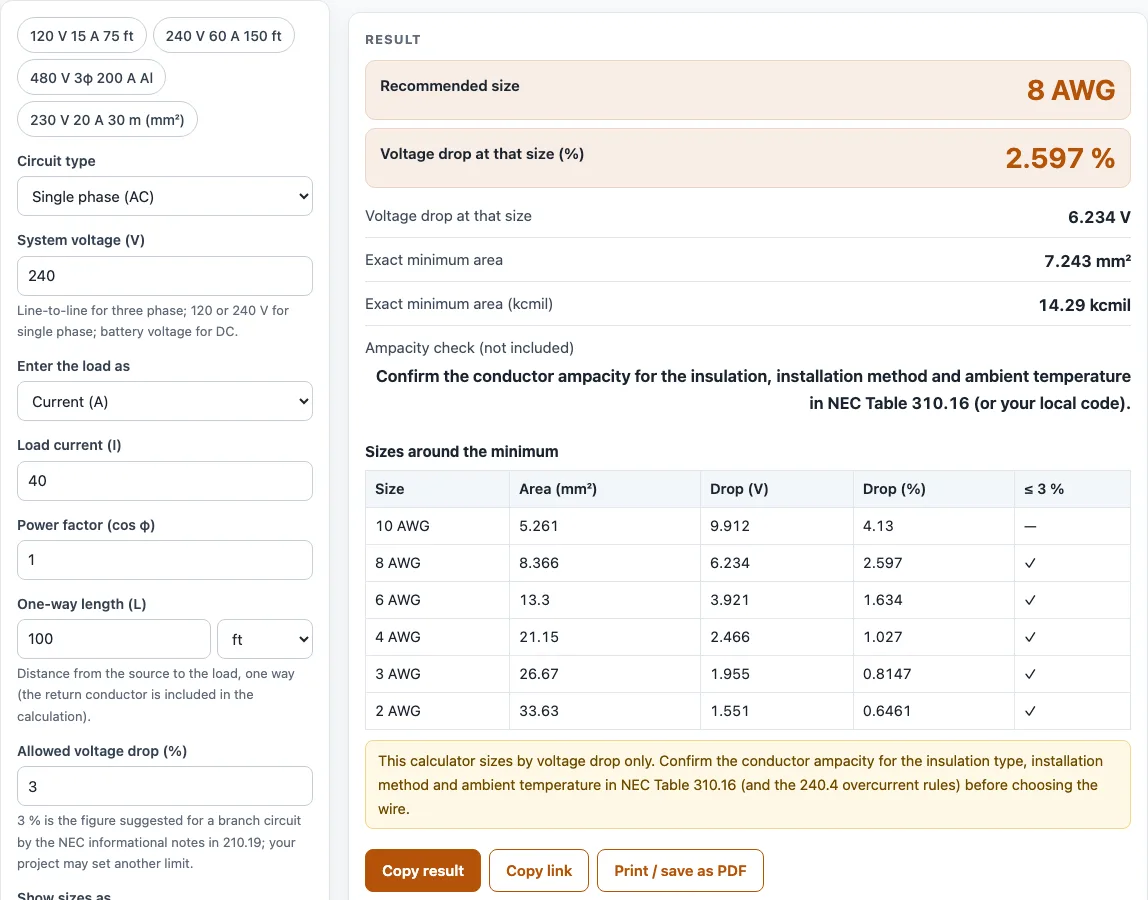
How to use the Wire Size Calculator
- Choose Circuit type: Single phase (AC), Three phase (AC) or DC.
- Enter System voltage (V). Use line-to-line voltage for three phase, 120 or 240 V for single phase, and battery voltage for DC.
- Under Enter the load as, pick Current (A) or Load power (W or kW). Then fill in Load current (I) or Load power. If shown, also enter Power factor (cos φ).
- Enter One-way length (L), the distance from the source to the load. The return conductor is included in the calculation.
- Set Allowed voltage drop (%). The default is 3 %.
- Choose Show sizes as: AWG, kcmil or Metric mm².
- Choose Conductor material: Copper or Aluminum.
- Optional: open More options to set Conductor temperature (20 °C, 60 °C, 75 °C or 90 °C) and tick Stranded conductor to add a 2 % lay allowance to the resistance.
- Read the result rows that apply to your mode, starting with Recommended size and Voltage drop at that size (%).
Four example buttons above the form load preset inputs, which is a quick way to see how the fields work. Under the result, Copy link stores every input in the page address so the same calculation reopens later. Print / save as PDF includes inputs, results, steps and the date. Reset restores the starting example.
What size wire do I need?
The right wire must pass two checks: its voltage drop must stay within your limit, and it must carry the current without overheating. This calculator performs the first check. It finds the smallest AWG, kcmil or mm² conductor whose voltage drop stays within the percentage you allow.
The second check, ampacity, comes from a table such as NEC Table 310.16, IEC 60364-5-52 or BS 7671. The allowed current depends on insulation temperature rating, installation method and ambient temperature. The calculator does not reproduce that wire size amp chart: the Ampacity check row in the result reminds you to look up the amperage for the wire size you choose, and the amp rating for a wire size changes with insulation and installation, so there is no single wire gauge and amperage list that fits every job.
How do I calculate wire size?
The calculator uses a voltage drop formula. For single phase and DC circuits, VD = 2 × L × I × R. For three phase circuits, VD = √3 × L × I × R. Here L is the one-way length, I is the load current, and R is the conductor resistance, which depends on the material and temperature.
The method works in three steps. First, find the allowed drop in volts by multiplying the system voltage by the limit. Second, calculate the drop for a trial size. Third, move to the next size up or down until you find the smallest wire whose drop stays within the allowed volts. The calculator does this search for you and shows the steps under “How it was calculated.”
For example, take 240 V single phase, 40 A, 100 ft of copper, with a 3 % limit. The allowed drop is 7.2 V. The tool recommends 8 AWG, which gives a drop of 6.234 V, or 2.6 %.
How does wire length affect wire size?
Voltage drop grows in direct proportion to length. In the formula, L is multiplied by the current and resistance, so doubling the one-way run doubles the drop for the same current and wire size. The wire must therefore be thicker to keep the same percentage drop.
This is why short runs can use small wire while long runs of the same load need much larger conductors. If the calculator reports that no size is enough, the run may simply be too long for the limit. You can shorten the run, raise the voltage, or use parallel conductors, as the warning suggests.
What does AWG mean?
AWG stands for American Wire Gauge, a standard system for numbering conductor sizes. Its numbers run backwards: a smaller number means a thicker wire. For example, 8 AWG is thicker than 10 AWG.
After 1 AWG, the sizes continue as 1/0, 2/0, 3/0 and 4/0. Larger conductors are then given in kcmil, such as 250, 300 and 350. Metric users can select mm² under Show sizes as, which lists the same conductors in square millimetres. For example, the 230 V, 20 A, 30 m example gives 4 mm².
Worked examples
| Input | Result |
|---|---|
| Single phase (AC), 240 V, 40 A, 100 ft, copper, 3 % allowed | 8 AWG (6.234 V, 2.6 %) |
| Single phase (AC), 120 V, 15 A, 75 ft, copper, 3 % allowed | 10 AWG (2.788 V, 2.32 %) |
| Single phase (AC), 240 V, 60 A, 150 ft, copper, 3 % allowed | 4 AWG (5.548 V, 2.31 %) |
| Three phase (AC), 480 V, 200 A, 250 ft, aluminum, 3 % allowed | 2/0 AWG (13.79 V, 2.87 %) |
| Single phase (AC), 230 V, 20 A, 30 m, copper, 3 % allowed | 4 mm² (6.416 V, 2.79 %) |
Calculated by the tool above with these values.
Frequently asked questions
What gauge wire do I need for 40 amps over 100 feet?
The answer depends on the voltage. For 240 V single phase copper with a 3 % limit, the calculator gives 8 AWG at a 2.6 % drop. Set the same load at a different voltage and the result changes, so enter your real system voltage before you choose a size.
Is 3 % the right allowed voltage drop?
The 3 % default is the figure the NEC informational notes in 210.19 suggest for a branch circuit. Your project may set a different limit. If you enter more than 5 %, the tool warns that this is above the 5 % total suggested in 210.19 and 215.2.
Does the calculator check ampacity?
No. It sizes the wire for voltage drop only. Use a current-carrying capacity table, such as NEC Table 310.16 or the equivalent in your standard, to confirm the chosen wire can carry the current at your insulation and ambient temperature.
What does the warning “not enough for this voltage drop limit” mean?
It means even the largest size the calculator checked cannot keep the drop within your limit. Use parallel conductors, a higher voltage or a shorter run, then recalculate.
Can I use the results in a quote or report?
Yes. Results, charts and printouts may be used freely in commercial work such as quotes, proposals, reports and service records. No attribution is needed.
Is the result a final design?
No. Every result is for estimation, so verify critical designs against the applicable standard.
Is my data uploaded anywhere?
No. The calculator runs entirely in your browser and nothing is uploaded.
Related tools
- Voltage drop calculator: Use it when you already have a wire size and want to see the drop it will produce.
- DC wire size calculator: Use it for battery and other direct current circuits.
- Cable size calculator: Use it when you are sizing a cable rather than a single conductor.
- Breaker size calculator: Use it to find a suitable breaker rating to pair with your wire.
- Watts to amps calculator: Use it to convert a load in watts to the current in amps.
- Electrical load calculator: Use it to add up connected loads before you size the supply wiring.
- All electrical calculators: Use it to browse every calculator on the site.
Sources
- NBS Handbook 100, Copper Wire Tables: copper resistivity 0.017241 Ω·mm²/m, temperature coefficient 0.00393/°C, AWG sizes, stranding allowance
- NBS Handbook 109, Aluminum Wire Tables, Table 1: EC aluminium 0.028264 Ω·mm²/m, 0.00403/°C
- NFPA 70, National Electrical Code (free online access): sections cited on this page; no tables are reproduced