Wire Resistance Calculator (Resistance of a Wire)
Pick the wire size, material and length to get its resistance in ohms.
The wire resistance calculator works out the electrical resistance of a copper or aluminum wire from its size, length and temperature. Pick a wire size in AWG, kcmil or mm², type a length in ft, m, km or mi, and choose the metal. The result appears in ohms, along with resistance per 1,000 ft, per km and per metre. Use it for a quick cable resistance calculation before you size a run or check voltage drop.
It runs in your browser, it is free, and nothing is uploaded. No sign-up is needed. The results are DC resistance only, so treat them as an estimate and verify critical designs against the applicable standard.
How to use the Wire resistance calculator
- In the Size system drop-down, choose AWG / kcmil or Metric (mm²).
- Pick a Wire size from the drop-down, such as 12 AWG or 2.5 mm².
- Type the Wire length and choose its unit: ft, m, km or mi.
- Under Conductor material, select Copper or Aluminum.
- In Length counts, choose One conductor only, or Out and back (2 × length) if the current returns through a second wire of the same size.
- Open More options to set the Conductor temperature (°C or °F; the default is 20 °C). Tick Stranded conductor (+2 %) if the wire is stranded.
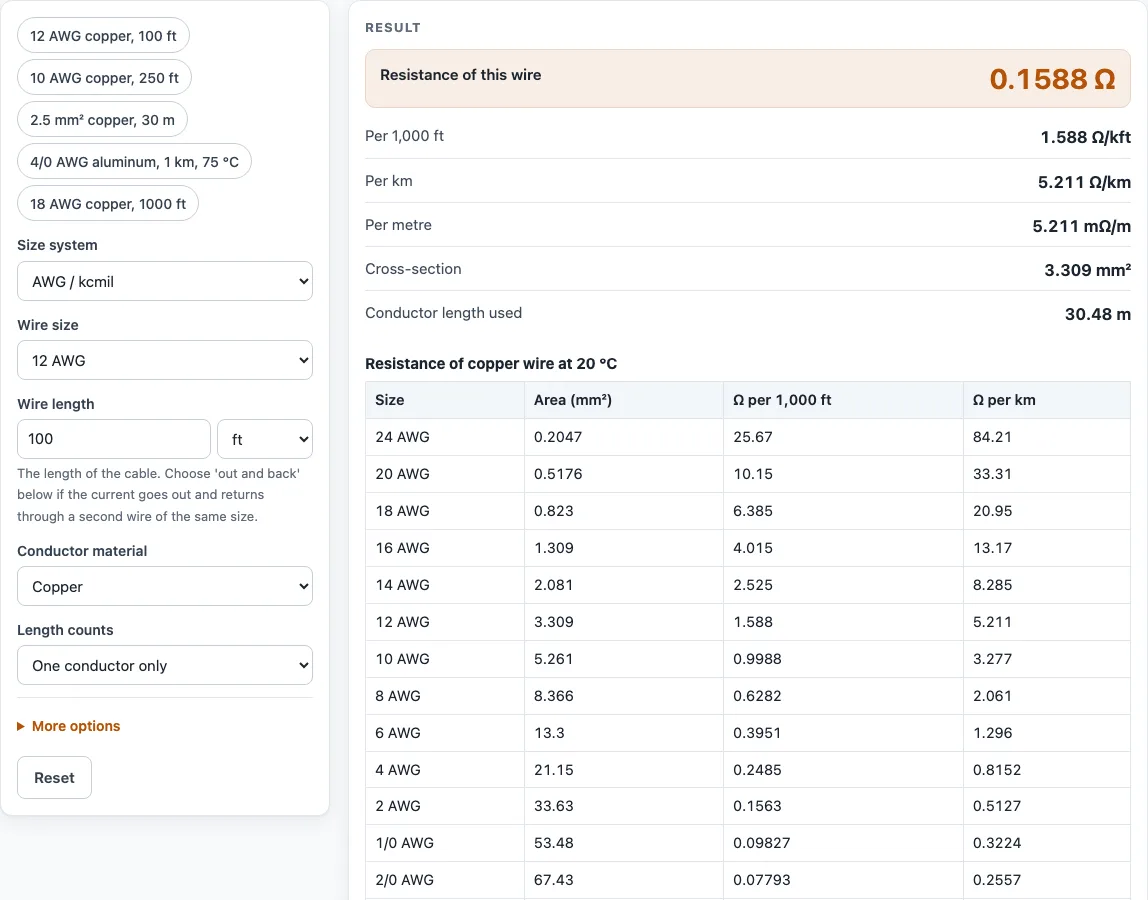
- Read the result rows. Resistance of this wire is your answer in ohms. The other rows give the resistance per 1,000 ft, per km and per metre (mΩ/m), the cross-section and the conductor length used.
- Open How it was calculated to see the resistivity at your temperature, the resistance per metre and the final multiplication.
The example buttons above the form fill in a set of inputs, such as 12 AWG copper at 100 ft, so you can see a finished calculation. Under the result, “How it was calculated” shows the formula with your numbers. Copy result, Copy link, Print / save as PDF and Reset sit below it. Copy link stores every input in the page address, so the same calculation reopens later.
How do you calculate the resistance of a wire?
Wire resistance is R = ρ × L ÷ A, where ρ is the resistivity of the metal, L is the length and A is the cross-sectional area. A longer wire adds resistance, and a thicker wire lowers it. Keep units consistent: with ρ in Ω·mm²/m, L in metres and A in mm², the result is in ohms.
The same formula is the core of any cable resistance calculation. The calculator applies it to your chosen size, length and metal.
What is the resistance of 12 AWG wire?
Solid copper 12 AWG wire has 1.588 Ω per 1,000 ft at 20 °C, which is 5.211 mΩ/m. A 100 ft run therefore has 0.1588 Ω. Aluminum of the same size and length has a higher value, covered below.
How do you find resistance per foot of wire?
Divide the published value per 1,000 ft by 1,000. For 12 AWG copper, 1.588 ÷ 1,000 = 0.001588 Ω per foot. Multiply that by your length to get the total. The calculator’s table lists Ω per 1,000 ft and Ω per km for each size at your chosen material and temperature, so you can check your figure against it.
How does temperature change wire resistance?
Resistance rises as temperature rises, because resistivity increases with temperature: ρ(T) = ρ20 × (1 + α × (T − 20)). For copper, α is 0.00393 per K. At 75 °C, the factor is 1 + 0.00393 × 55 = 1.216, so the resistance is about 21.6 % higher than at 20 °C. The 20 °C default matches published wire tables, so change the temperature when your wire will run hot.
Why is aluminum wire resistance higher than copper?
Aluminum has a higher resistivity than copper. At 20 °C it is 0.028264 Ω·mm²/m, against 0.017241 Ω·mm²/m for annealed copper. That is about 1.64 times the resistance for the same size and length. To match the resistance of a copper wire, an aluminum wire must have a larger cross-section. For example, 4/0 AWG aluminum over 1 km at 75 °C gives 0.322 Ω.
Worked examples
| Input | Result |
|---|---|
| 12 AWG copper, 100 ft, 20 °C | 0.1588 Ω |
| 10 AWG copper, 250 ft, 20 °C | 0.2497 Ω |
| 2.5 mm² copper, 30 m, 20 °C | 0.2069 Ω |
| 4/0 AWG aluminum, 1 km, 75 °C | 0.322 Ω |
| 18 AWG copper, 1000 ft, 20 °C | 6.385 Ω |
Calculated by the tool above with these values.
Frequently asked questions
What does Out and back (2 × length) mean?
Choose it when current goes out through one wire and returns through a second wire of the same size. The calculator doubles the length, so the result covers the full loop. Use One conductor only for a single wire run.
Does this calculator give voltage drop or AC impedance?
No. It gives DC resistance only, with no AC impedance, skin effect or voltage drop. The voltage drop calculator uses this resistance together with the current.
What does the Stranded conductor (+2 %) option change?
It multiplies the resistance by 1.02, because stranded wire is slightly higher in resistance than solid wire of the same size. Leave it unticked for solid conductors.
Why does the calculator warn above 105 °C?
Above 105 °C is beyond the temperature ratings of ordinary insulated cable. The result is still shown, but check the value against the cable’s rating.
Can I use a temperature in °F?
Yes. Choose °F in the unit list beside Conductor temperature and the calculator converts it to °C. For example, 167 °F is the same as 75 °C.
Can I rely on these results for a final design?
Use them for estimates. For critical designs, check the applicable standard and the cable maker’s data, which is the final word.
Related tools
- Voltage drop calculator: use it when you need the voltage lost along a run at a given current.
- Wire size calculator: use it when you know the load and need to find a suitable wire size.
- AWG to mm2 calculator: use it to convert a wire size between AWG and square millimetres.
- Ohm’s law calculator: use it to relate voltage, current and resistance in a circuit.
- Cable size calculator: use it to compare cable sizes for a given installation.
- All electrical calculators: use it to browse every electrical calculator on the site.
Sources
- NBS Handbook 100, Copper Wire Tables: copper resistivity 0.017241 Ω·mm²/m at 20 °C, temperature coefficient 0.00393/K, AWG sizes, stranding allowance
- NBS Handbook 109, Aluminum Wire Tables, Table 1: EC aluminium 0.028264 Ω·mm²/m, 0.00403/K
- American wire gauge (Wikipedia): published copper resistance at 20 °C used to check the results (for example 12 AWG 1.588 Ω per 1,000 ft)