Wire Bundle Diameter Calculator
Enter how many wires you have and their outside diameter to get the bundle diameter.
This wire bundle diameter calculator gives the outside diameter of a round bundle of identical wires or cables. Enter the number of wires and the outside diameter of one wire, and the calculator returns the tightest possible bundle and the size at a fill percentage you choose. Use it to pick a sleeve, grommet, conduit or cable gland before you pull the wires.
For up to 20 wires the tight figure comes from the known best circle packings, so it is the smallest circle that can hold that many wires. For larger counts it gives the ideal-packing lower limit, and the fill figure gives a realistic size. The calculator runs in your browser, is free, needs no sign-up, and nothing is uploaded.
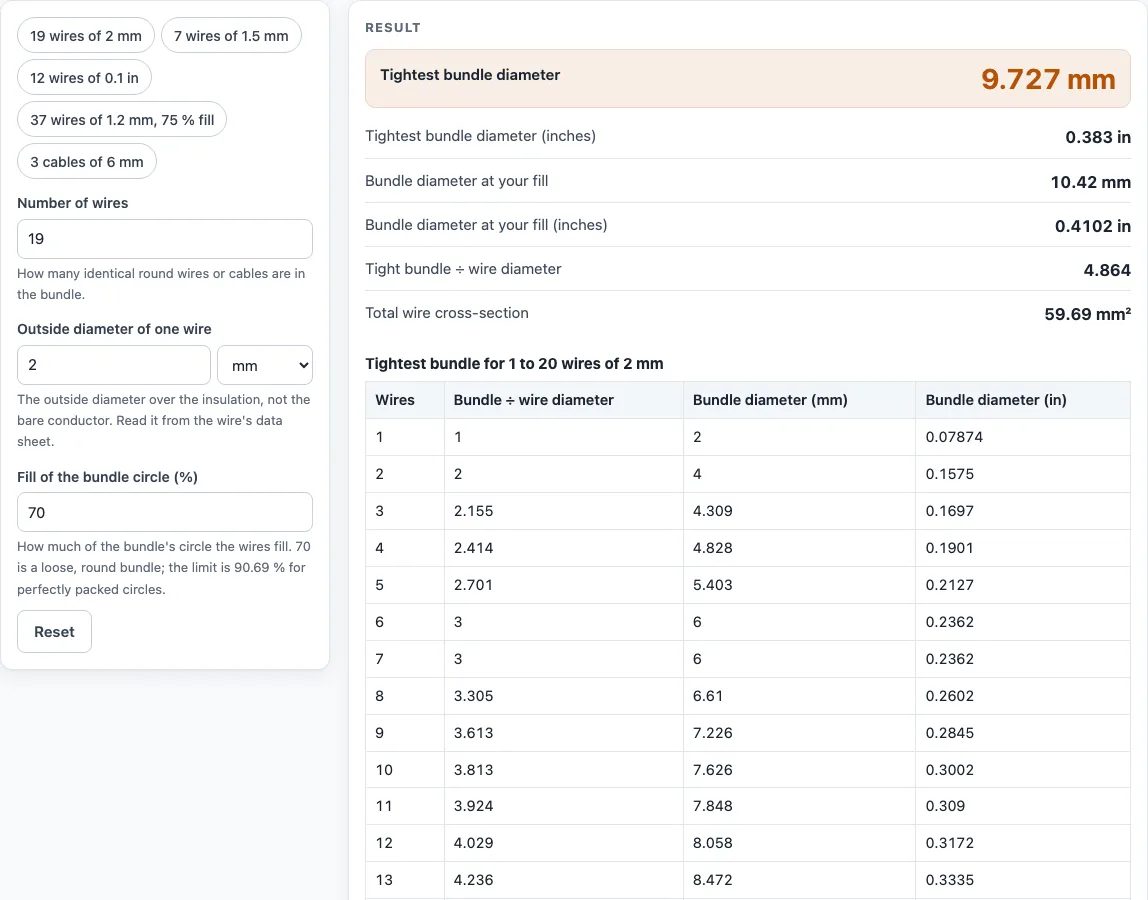
How to use the wire bundle diameter calculator
- Type the Number of wires in the bundle. All wires are treated as identical.
- Type the Outside diameter of one wire and choose mm or in. Use the diameter over the insulation, from the wire’s data sheet.
- Set the Fill of the bundle circle (%). The default 70 is a loose, round bundle. The highest allowed value is 90.69 %, the limit for perfectly packed circles.
- Read Tightest bundle diameter and Bundle diameter at your fill, in mm and inches. Tight bundle ÷ wire diameter shows the ratio, and Total wire cross-section adds up the wire areas.
- Open How it was calculated to see the numbers used. The table under the result lists the tightest bundle for 1 to 20 wires of your diameter.
The example buttons above the form, such as 19 wires of 2 mm, load common cases. Copy result, Copy link and Print / save as PDF sit under the result. Copy link stores every input in the page address, so the same calculation reopens later, and Reset returns the form to its starting values. Change the fill to see how a looser or tighter bundle changes the size, and compare the result with the sleeve or conduit you plan to use.
How do you calculate the diameter of a wire bundle?
A bundle of N round wires of diameter d fits in a circle of diameter D. For small N the smallest circle is known exactly: one wire needs D = d, two wires need 2d, three wires 2.155d, and seven wires 3d (one in the centre, six around it). Wikipedia’s table of circle packing in a circle lists the ratio for 1 to 20 circles, and the calculator uses it.
What is the formula for many wires?
For a large number of wires, divide the total wire area by the fill fraction: D = d × √(N ÷ fill). Perfect hexagonal packing fills π ÷ √12 = 90.69 % of the circle, so no bundle can be smaller than d × √(N ÷ 0.9069). A fill of 70 % gives a bundle about 14 % wider than the hexagonal limit.
What is the bundle diameter of 7 wires?
Seven equal wires fit in a circle of three wire diameters: one wire in the centre and six touching it. Seven wires of 1.5 mm make a bundle at least 4.5 mm across. At 70 % fill the same wires need about 4.74 mm.
How many wires does a round bundle hold?
The table works in both directions. Seven wires need a bundle of three wire diameters, and nineteen wires need 4.864 diameters. Between 7 and 19 wires the bundle grows from 3 to 4.864 wire diameters, which is why adding the eighth wire to a seven-wire bundle makes a visible jump in size.
Why is a real bundle larger than the table value?
The table assumes perfectly round, rigid wires placed in the best arrangement. Real wires bend, twist and sit in a ring around a core, so the fill is lower. Add a margin when choosing a sleeve or conduit, and check the cable maker’s data for the real outside diameter of a multi-core cable.
Worked examples
| Input | Result |
|---|---|
| 19 wires, 2 mm each, 70 % fill | 9.727 mm tight, 10.42 mm at 70 % fill |
| 7 wires, 1.5 mm each, 70 % fill | 4.5 mm tight, 4.743 mm at 70 % fill |
| 12 wires, 0.1 in each, 70 % fill | 10.23 mm tight, 10.52 mm at 70 % fill |
| 37 wires, 1.2 mm each, 75 % fill | 7.665 mm tight, 8.429 mm at 75 % fill |
| 3 wires, 6 mm each, 70 % fill | 12.93 mm tight, 12.93 mm at 70 % fill |
Calculated by the tool above with these values.
Frequently asked questions
Should I use the conductor diameter or the insulation diameter?
Use the outside diameter over the insulation. The bare conductor diameter underestimates the bundle. For a different wire size, look up the AWG or mm² size on the wire’s data sheet.
What fill should I choose?
70 % is a loose round bundle and a sensible start. A tightly taped harness may be closer to 75 %, and 90.69 % is only a theoretical limit. If the fill is too high for a small number of wires, the calculator shows the tight figure instead, because few wires cannot pack that tightly.
Does it work for different wire sizes in one bundle?
No. All wires are treated as the same size. For mixed sizes, use the largest diameter for a safe estimate.
How many wires fit in a given diameter?
Divide the bundle diameter by the wire diameter and compare the ratio with the table. For example, a ratio of 4.8 holds up to 17 wires in the tightest packing, as 17 wires need 4.792 and 18 need 4.864.
Can I use this for cables with several cores?
Yes, if you treat each cable as one round wire and enter its outside diameter. The result is the circle that holds all the cables together, for example in a gland or a conduit.
Can I use inches?
Yes. Choose in beside the wire diameter. The result is shown in both mm and inches.
Related tools
- Wire size calculator: use it to pick a wire size for the load and voltage drop.
- Cable size calculator: use it to compare cable sizes in mm².
- AWG to mm2 calculator: use it to convert a wire size between AWG and square millimetres.
- Wire resistance calculator: use it to find the resistance of a run of wire.
- Conduit bending calculator: use it to get bend marks for the conduit the wires run in.
- All electrical calculators: use it to browse every electrical calculator on the site.
Sources
- Circle packing in a circle (Wikipedia): enclosing radius of N equal circles, N = 1 to 20
- Hexagonal packing density π ÷ √12 = 0.9069: the densest packing of equal circles in the plane (a standard result; the site’s unit test recomputes the value)