Transformer Turns Ratio Calculator
Find the turns ratio, the secondary voltage or the number of secondary turns of an ideal transformer.
This transformer turns ratio calculator finds the turns ratio of a transformer from its voltages, or the secondary voltage or turns from the ratio. Type the primary voltage and two of the other three values (secondary voltage, primary turns, secondary turns) and read the answer, with the voltage per turn and the impedance ratio.
It treats the transformer as ideal, which is the standard way to size a winding or check a nameplate. Add the rating in VA or kVA and it also gives the primary and secondary current. The calculator runs in your browser, is free and needs no sign-up, and nothing is uploaded.
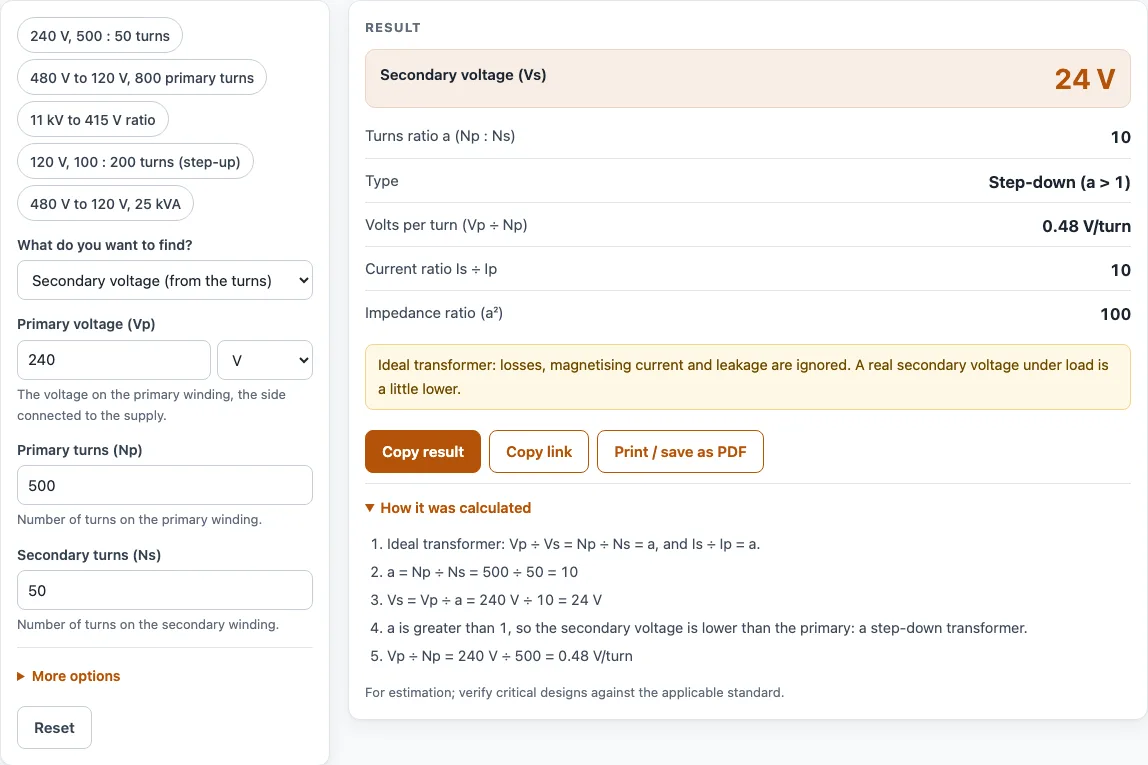
How to use the transformer turns ratio calculator
- In What do you want to find? choose Secondary voltage (from the turns), Secondary turns (from the voltages) or Turns ratio (from the voltages).
- Type the Primary voltage (Vp) and choose V or kV.
- For the secondary voltage, enter Primary turns (Np) and Secondary turns (Ns).
- For the secondary turns, enter the wanted Secondary voltage (Vs) and the Primary turns (Np).
- For the turns ratio, enter the Secondary voltage (Vs). Only Vp and Vs are needed.
- Optional: open More options and enter the Transformer rating (optional) in VA or kVA to get Primary current (Ip) and Secondary current (Is).
- Read the main result, Type (step-down, step-up or isolation), Volts per turn, Current ratio and Impedance ratio (a²).
The example buttons above the form, such as 480 V to 120 V with 25 kVA, fill in a finished case. Copy result, Copy link and Print / save as PDF sit under the result. Copy link stores every input in the page address, so the same calculation reopens later. Reset returns the form to its starting values. If a field you expect is missing, check the first drop-down: each choice only shows the fields it needs, so the form stays short.
What is the turns ratio of a transformer?
The turns ratio a is the number of primary turns divided by the number of secondary turns: a = Np ÷ Ns. For an ideal transformer it also equals the voltage ratio Vp ÷ Vs, and the current ratio Is ÷ Ip. A 240 V primary with 500 turns and a 50-turn secondary has a = 10 and gives 24 V.
How do you calculate secondary voltage from the turns?
Use Vs = Vp × Ns ÷ Np. With 120 V on 100 primary turns and 200 secondary turns, Vs = 120 × 200 ÷ 100 = 240 V, so the transformer steps the voltage up. The calculator shows the same working under the result.
Is a step-up transformer a ratio below 1 or above 1?
With a = Np ÷ Ns, a step-down transformer has a greater than 1 and a step-up transformer has a less than 1, as stated in Wikipedia’s article on the transformer. If a equals 1, the voltage is unchanged and the unit is an isolation transformer. Some books quote the ratio the other way round, so check which convention a nameplate uses.
How do you find the turns for a wanted voltage?
Use Ns = Np × Vs ÷ Vp. For 480 V to 120 V with 800 primary turns, Ns = 800 × 120 ÷ 480 = 200 turns. If the answer is not a whole number, the calculator also shows the nearest whole number of turns and the secondary voltage you get with it, because a winding cannot have a fraction of a turn.
Why do designers use volts per turn?
Because every turn on the same core sees the same voltage, volts per turn lets you check a winding quickly. If a primary of 500 turns at 240 V gives 0.48 V per turn, a 50-turn secondary gives 24 V and a 100-turn secondary gives 48 V. A core that saturates at a given volts per turn needs more turns or a larger core.
What current does the ratio give?
Current changes in the opposite direction to voltage. A 25 kVA transformer at 480 V draws 52.08 A on the primary, and at 120 V it supplies 208.3 A on the secondary. The calculator uses single-phase VA. The current ratio Is ÷ Ip equals the turns ratio a.
Worked examples
| Input | Result |
|---|---|
| Vp 240 V, 500 : 50 turns | Vs 24 V |
| Vp 480 V, Vs 120 V | Ns 200 turns |
| Vp 11 kV, Vs 415 V | a = 26.51 |
| Vp 120 V, 100 : 200 turns | Vs 240 V |
| Vp 480 V, Vs 120 V | a = 4 |
Calculated by the tool above with these values.
Frequently asked questions
Does this work for a three-phase transformer?
The turns ratio is per winding. For a three-phase transformer, divide the phase voltages by the winding turns, and the line voltages follow the connection (delta or wye). The current figures here are single phase, so use the three-phase rating tools for line currents.
What is the impedance ratio?
A load of impedance Zs on the secondary appears on the primary as Zp = a² × Zs. With a ratio of 10, the primary sees 100 times the secondary load impedance. The calculator shows a² as the impedance ratio.
Why is the real secondary voltage lower under load?
The calculator assumes an ideal transformer. In a real one, winding resistance and leakage reactance cause a small voltage drop under load, and the open-circuit secondary voltage is a little higher than the loaded one. Use the manufacturer’s regulation figure for a final design.
What does volts per turn mean?
It is the primary voltage divided by the primary turns, which is the voltage across every turn of every winding on the same core. A design with 0.48 V per turn gives 24 V from 50 turns.
What accuracy can I expect?
The arithmetic is exact for an ideal transformer. Real transformers differ slightly because of winding resistance, leakage and core losses, so measured voltages are within a few per cent of the ideal ones and the loaded secondary voltage is lower. Treat the result as a design starting point and confirm it with a nameplate or a test.
Can I enter kV for the voltages?
Yes. Choose kV beside the voltage field. For example, 11 kV to 415 V gives a turns ratio of 26.5.
Related tools
- Transformer sizing calculator: use it to pick the kVA size for a given load.
- kVA calculator: use it to convert between amps and kVA.
- kVA to kW calculator: use it to turn apparent power into real power.
- Three phase power calculator: use it for line and phase voltages and currents.
- RMS voltage calculator: use it to convert between RMS, peak and peak-to-peak voltage.
- All electrical calculators: use it to browse every electrical calculator on the site.
Sources
- Transformer (Wikipedia): ideal transformer equations Vp/Vs = Np/Ns = a, Is/Ip = a, Zp = a² × Zs; step-up a < 1 and step-down a > 1