Transformer Sizing Calculator
Enter the load and voltages to get the kVA you need, the standard transformer size and its primary and secondary currents.
How to use the Transformer sizing calculator
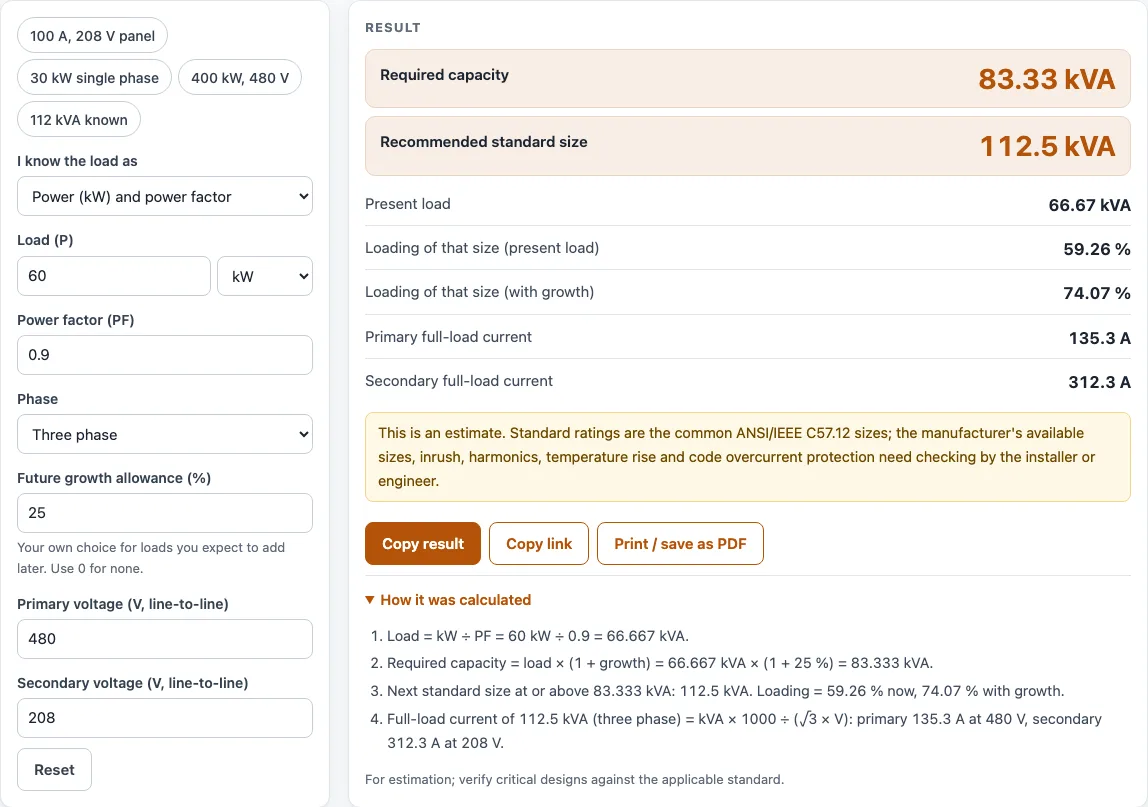
- Open the “I know the load as” drop-down and choose Power (kW) and power factor, Apparent power (kVA), or Current (A) at the secondary voltage.
- Fill in the input that appears for your choice: Load (P) in kW or W, Power factor (PF), Load (kVA), or Load current (A).
- Choose Phase: Three phase or Single phase.
- Enter the Future growth allowance (%). The default is 25%. Enter 0 if you expect no added load.
- Enter the Primary voltage (V, line-to-line) and the Secondary voltage (V, line-to-line).
- Read the results. Only the rows that apply to your mode appear: Required capacity, Recommended standard size, Present load, Loading of that size (present load), Loading of that size (with growth), Primary full-load current, and Secondary full-load current.
- Check any warning shown below the results, then open “How it was calculated” to see each step with your own numbers.
The example buttons above the form fill in sample loads, such as 100 A at 208 V, 30 kW single phase, 400 kW, and 112 kVA. Reset restores the starting example. Copy result copies the result lines with a link, Copy link stores every input in the page address so the same calculation reopens later, and Print / save as PDF prints your inputs, results, steps, and the date.
How do you size a transformer?
To size a transformer, find your load in kVA, multiply it by 1 plus the growth allowance, and pick the next standard size at or above that figure. The growth allowance defaults to 25%, and it is your own choice for loads you expect to add later.
For example, a 60 kW load at power factor 0.9 is 66.7 kVA. With 25% growth, the required capacity is 83.3 kVA, so the recommended size is 112.5 kVA. Motor starting, harmonics from non-linear loads, and high ambient temperature can all call for a larger transformer, so check the final choice with the manufacturer before you order.
How do you calculate transformer kVA?
Transformer kVA is the load’s apparent power. For a load given in kW, divide kW by the power factor. For a load given as current, multiply voltage by current. Use √3 × V × I ÷ 1,000 for three phase and V × I ÷ 1,000 for single phase.
Take 100 A at 208 V on a three phase circuit. That gives a load of about 36 kVA before growth, and the calculator’s required capacity is 45.03 kVA with 25% growth. The recommended standard size is 75 kVA. The full-load current on each side is worked out from the same kVA and the voltage on that side. For the 112.5 kVA example at 480 V primary and 208 V secondary, that is 135.3 A on the primary and 312.3 A on the secondary, which is what the overcurrent protection and conductors on each side are sized from. The loading row shows how full the chosen size will be: 59 % today and 74 % with the growth allowance in that example.
Worked examples
| Input | Result |
|---|---|
| 60 kW, PF 0.9 | 83.33 kVA required, use 112.5 kVA |
| 100 A at 208 V | 45.03 kVA required, use 75 kVA |
| 30 kW, PF 1 | 37.5 kVA required, use 37.5 kVA |
| 400 kW, PF 0.85 | 588.2 kVA required, use 750 kVA |
| 112 kVA | 140 kVA required, use 150 kVA |
Calculated by the tool above with these values.
Frequently asked questions
What size transformer do I need for my load?
Start with your load in kVA, add your growth allowance, and choose the next standard size at or above the result. The calculator does these steps for you when you enter your load values and phase.
What are standard transformer sizes?
Standard single phase sizes are 10, 15, 25, 37.5, 50, 75, 100, 167, 200, 250 and 333 kVA (Schneider Electric’s published list). Standard three phase sizes are 15, 30, 45, 75, 112.5, 150, 225, 300, 500, 750, 1,000, 1,500, 2,000, and 2,500 kVA. These are the sizes the calculator recommends from.
Why is the recommended size larger than the required capacity?
Transformers come only in standard ratings, so the calculator rounds up to the next one. The gap between the required capacity and the recommended size is margin for your load and any growth.
What growth allowance should I use?
The default is 25%, but the value is your choice. Use a figure that matches the loads you expect to add. Enter 0 if you expect no added load.
What if the required capacity is above the largest size in the list?
The calculator shows a warning when the required capacity is above 2,500 kVA, the largest size listed. Use several transformers or an engineered design for that load.
Can I use these results as a final design?
The results are an estimate. Standard ratings follow the sizes Schneider Electric publishes as standard, but the manufacturer’s available sizes, inrush, harmonics, temperature rise, and code overcurrent protection need checking by the installer or engineer.
Related tools
- kVA calculator: Use it to convert kW, power factor, voltage, and current into kVA before you size a transformer.
- Fault current calculator: Use it when you need the fault current at a point in the system.
- kVA to kW calculator: Use it to convert a kVA rating into kW at a given power factor.
- Three phase power calculator: Use it to work out power for three phase loads.
- Electrical load calculator: Use it to total the loads that a transformer or circuit must carry.
- Power factor calculator: Use it to find the power factor when you know the kW and kVA.
- All electrical calculators: Use it to browse every calculator on the site.
Sources
- Schneider Electric FAQ FA91532: standard transformer kVA ratings (checked Oct 2026)