Three Phase Power Calculator
Enter the line voltage, current and power factor to get three-phase kW, kVA and kvar, or find the current from the power.
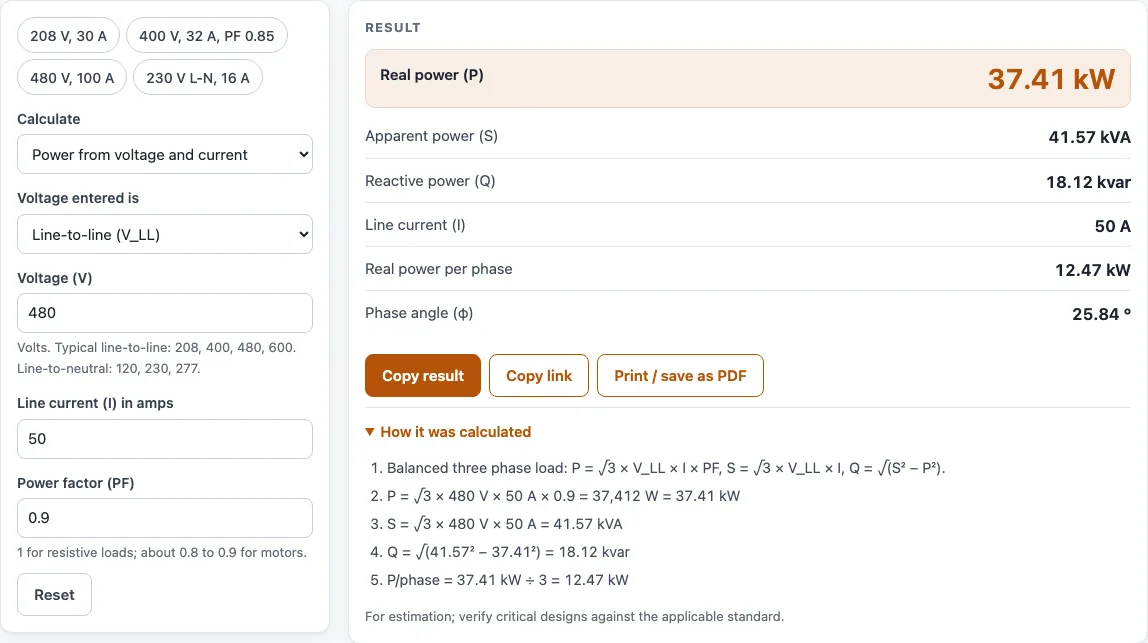
How to use the Three-phase power calculator
- Open the Calculate drop-down and choose a mode: Power from voltage and current, Current from power, or Line-to-line and line-to-neutral voltage.
- Set Voltage entered is to Line-to-line (V_LL) or Line-to-neutral (V_LN), matching the voltage you measured or read from the nameplate.
- Type the voltage in Voltage (V). Typical line-to-line values are 208, 400, 480 and 600 V.
- If it appears, type the Line current (I) in amps. This box only shows in some modes.
- If it appears, type the Real power (P) and choose its unit: kW, W, MW or hp.
- Enter the Power factor (PF). Use 1 for resistive loads and about 0.8 to 0.9 for motors.
- Read the result rows. Only the rows that apply to your mode appear. If a warning shows, check the power factor or current value before you rely on the result.
- Scroll to How it was calculated to see the formula and each step with your own numbers.
To try a known case first, press one of the example buttons, such as 208 V or 480 V. Copy result copies the result lines and a link. Copy link stores every input in the page address, so the same calculation reopens later. Print / save as PDF produces a file with the inputs, results, steps and date. Reset restores the starting example.
What is the three phase power equation?
Real power in a three-phase circuit is P (W) = √3 × V_LL × I × PF, where V_LL is the line-to-line voltage in volts, I is the line current in amps, and PF is the power factor. Apparent power is S (VA) = √3 × V_LL × I, and reactive power is Q = √(S² − P²).
Current can be found by rearranging the power formula: I = P ÷ (√3 × V_LL × PF). For a balanced load, each phase carries one third of the total power.
As an example, a 480 V line-to-line supply carrying 50 A at a power factor of 0.9 gives 37.41 kW of real power, 41.57 kVA of apparent power and 18.12 kvar of reactive power.
Why is the square root of 3 used in three-phase power?
The square root of 3 (about 1.732) is used because in a three-phase system the line-to-line voltage is √3 times the voltage from one line to neutral. The term converts between the two voltage measurements, so the formula works with the line-to-line value.
The calculator accepts either voltage type. Line-to-line is 208 V for 120 V line-to-neutral, 480 V for 277 V and 400 V for 230 V. A single-phase load connected line-to-line on a three-phase system does not use √3. It uses I = P ÷ (V × PF).
How do you calculate three phase current from power?
Rearrange the 3 phase power equation for current: I = P ÷ (√3 × V_LL × PF). This three phase AC power calculation is what the Current mode does. A 30 kW load at 400 V and PF 0.85 draws 30,000 ÷ (1.732 × 400 × 0.85) ≈ 50.9 A per line. The same 3 phase AC power calculation at 480 V gives about 42.5 A, so a higher supply voltage lowers the current for the same power.
For a quick sense of scale: 208 V × 30 A at PF 1 is 10.8 kW, and 480 V × 100 A at PF 0.9 is 74.8 kW.
Worked examples
| Input | Result |
|---|---|
| 208 V line-to-line, 30 A, PF 0.9 | 9.727 kW, 10.81 kVA |
| 400 V line-to-line, 32 A, PF 0.85 | 18.84 kW, 22.17 kVA |
| 480 V line-to-line, 100 A, PF 0.9 | 74.82 kW, 83.14 kVA |
| 230 V line-to-neutral, 16 A, PF 1 | 11.04 kW, 11.04 kVA |
| 10 kW, 480 V line-to-line, PF 0.85 | 14.15 A |
Calculated by the tool above with these values.
Frequently asked questions
How do you calculate three-phase current?
Divide the real power by √3 × V_LL × PF. For 10 kW at 480 V line-to-line and a power factor of 0.85, the current is 14.15 A.
What is the difference between line and phase voltage?
Line-to-line voltage is measured between two phase conductors. Line-to-neutral voltage is measured between one phase conductor and the neutral. The calculator labels the second value V_LN, and line-to-line equals √3 times line-to-neutral.
How many kW is a 3 phase 100 amp supply?
It depends on the voltage and power factor. At 480 V line-to-line and a power factor of 0.9, a 100 A supply gives 74.82 kW (83.14 kVA). Change either value and the result changes, so enter your own numbers to check.
Can I convert 1 phase to 3 phase with a formula?
No. A formula cannot turn a single-phase supply into a three-phase one. A single-phase load connected line-to-line on a three-phase system is calculated with I = P ÷ (V × PF).
What power factor should I enter?
Use 1 for resistive loads such as heaters and the nameplate power factor for motors. If you enter a value below 0.5, the calculator shows a warning, because that is unusually low for a real load.
Why does the calculator warn about high current?
It warns when the line current is very high. Check the voltage and power first. A higher voltage or parallel feeders may be a better option than a single feeder carrying that current.
Related tools
- kW to amps calculator: use it to find the current for a given power when you already know the voltage and power factor.
- kVA calculator: use it to find apparent power when you need the total load in volt-amperes.
- kVA to kW calculator: use it to convert apparent power to real power using the power factor.
- Power factor calculator: use it to work out the power factor from real and apparent power.
- Watts to amps calculator: use it for a quick current estimate from wattage and voltage.
- Transformer sizing calculator: use it to estimate the transformer rating needed for a load.
- All electrical calculators: use it to browse every calculator on the site.
Sources
- OpenStax University Physics Vol. 2, §15.4 Power in an AC circuit: real power and power factor
- NIST SP 811: unit conversions (1 hp = 745.7 W)