RMS Voltage Calculator (Vpp to Vrms)
Enter one voltage of a waveform and get its RMS, peak, peak-to-peak and average values.
This RMS voltage calculator converts between the RMS, peak, peak-to-peak and average voltage of a repeating waveform. Choose the waveform, say which value you already know, type it in, and the other three appear at once, together with the crest factor and form factor. It handles sine waves such as mains power, symmetric square and triangle waves, and half-wave and full-wave rectified sine waves.
The RMS value is the number that matters for power: a sine wave of 120 V RMS heats a resistor exactly as much as 120 V DC. An oscilloscope, however, usually shows peak or peak-to-peak, so you often need a Vpp to Vrms conversion. The calculator runs in your browser, is free, needs no sign-up, and nothing is uploaded.
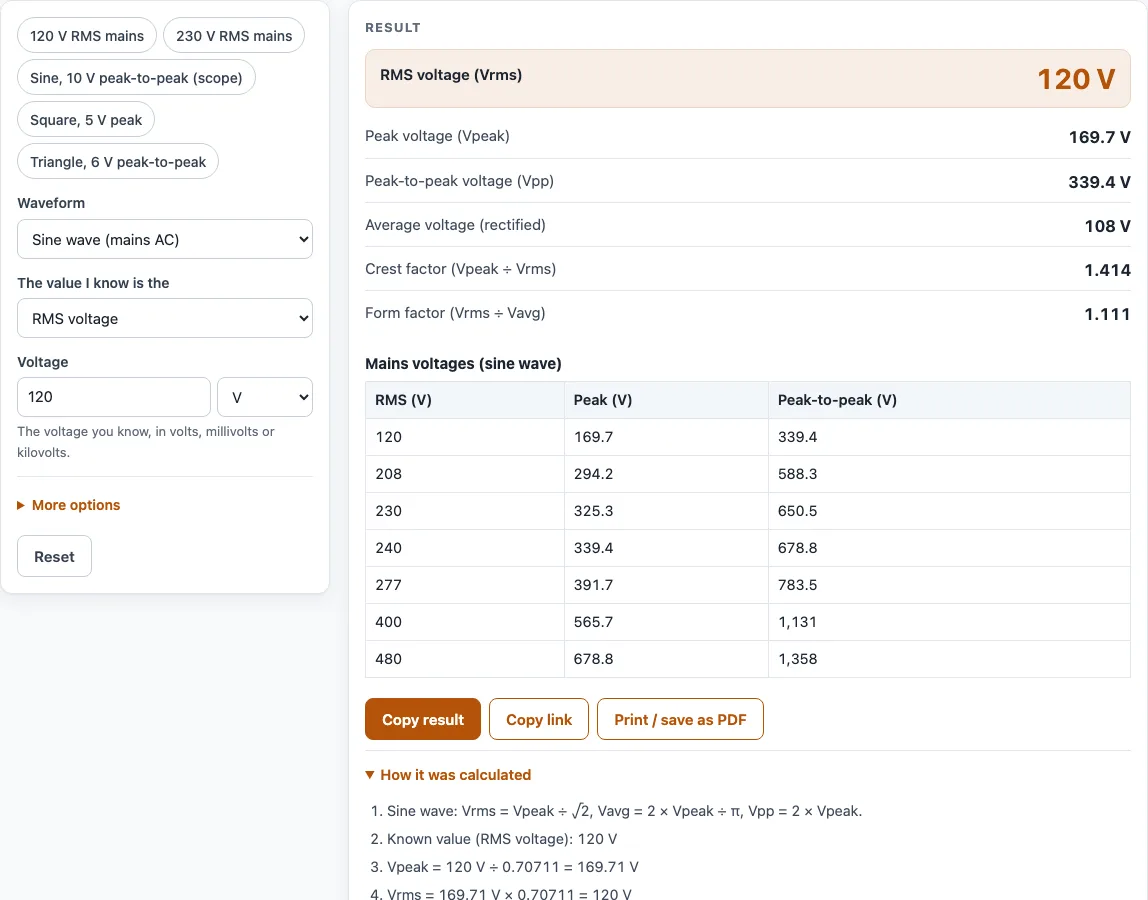
How to use the RMS voltage calculator
- In the Waveform drop-down, choose Sine wave, Square wave, Triangle wave, Full-wave rectified sine or Half-wave rectified sine.
- In The value I know is the, choose RMS voltage, Peak voltage, Peak-to-peak voltage or Average voltage (rectified).
- Type the Voltage and pick V, mV or kV.
- Optional: open More options and enter a Load resistance (optional) to get the power the waveform delivers into that resistor.
- Read RMS voltage (Vrms), Peak voltage (Vpeak), Peak-to-peak voltage (Vpp) and Average voltage (rectified). Crest factor and Form factor show how peaky the wave is.
- Open How it was calculated to see each factor applied to your number. The example buttons above the form, such as 120 V RMS mains, load typical cases.
Copy result, Copy link and Print / save as PDF sit under the result. Copy link stores your inputs in the page address, so the same calculation reopens later. If you measured the voltage with an oscilloscope, choose Peak-to-peak voltage as the known value; if you read it on a multimeter, choose RMS voltage. For a rectified signal from a bridge or a single diode, choose the full-wave or half-wave option so the peak-to-peak and average values use the right definition. The warnings under the result remind you of those definitions whenever they apply.
How do you convert Vpp to Vrms?
For a sine wave, Vpp = 2 × Vpeak and Vrms = Vpeak ÷ √2, so Vrms = Vpp ÷ (2√2), which is about Vpp × 0.3536. A 10 V peak-to-peak sine therefore has a peak of 5 V and an RMS value of 3.536 V. Other waveforms use other factors, so pick the right waveform first.
What are the RMS formulas for common waveforms?
With Vpeak as the peak value, a sine wave has Vrms = Vpeak ÷ √2, a symmetric square wave has Vrms = Vpeak, and a symmetric triangle wave has Vrms = Vpeak ÷ √3. The same RMS relations are listed on Wikipedia’s page on the root mean square. A full-wave rectified sine keeps the sine’s RMS (Vpeak ÷ √2), while a half-wave rectified sine is Vpeak ÷ 2, because half the time it is zero.
What is the peak voltage of 120 V and 230 V mains?
Mains voltage is quoted as RMS. A 120 V RMS supply peaks at 120 × √2 = 169.7 V and swings 339.4 V peak-to-peak. A 230 V supply peaks at 325.3 V and swings 650.5 V peak-to-peak. The table under the result lists the common mains voltages from 120 V to 480 V.
What do crest factor and form factor mean?
Crest factor is the peak divided by the RMS value: 1.414 for a sine wave, 1 for a square wave and 1.732 for a triangle wave. Form factor is the RMS value divided by the average of the rectified wave: 1.111 for a sine wave, which is why simple average-responding meters are calibrated with that factor.
Why is the average of a sine wave listed as rectified?
A symmetric wave spends as long below zero as above it, so its plain average is zero. The calculator reports the average of the absolute value, which is 2 × Vpeak ÷ π, about 0.637 × Vpeak, for a sine wave. For the rectified waves the plain average and the rectified average are the same.
Worked examples
| Input | Result |
|---|---|
| Sine wave (mains AC), 120 V RMS voltage | Vrms 120 V, Vpeak 169.7 V, Vpp 339.4 V |
| Sine wave (mains AC), 230 V RMS voltage | Vrms 230 V, Vpeak 325.3 V, Vpp 650.5 V |
| Sine wave (mains AC), 10 V Peak-to-peak voltage | Vrms 3.536 V, Vpeak 5 V, Vpp 10 V |
| Square wave (symmetric), 5 V Peak voltage | Vrms 5 V, Vpeak 5 V, Vpp 10 V |
| Triangle wave (symmetric), 6 V Peak-to-peak voltage | Vrms 1.732 V, Vpeak 3 V, Vpp 6 V |
Calculated by the tool above with these values.
Frequently asked questions
Is RMS the same as the average voltage?
No. RMS is the equivalent heating value, while the average of a sine wave is either zero or, once rectified, 0.637 × Vpeak. For a sine wave the RMS value is 0.707 × Vpeak, which is about 11 % higher than the rectified average.
Does a true RMS meter change the answer?
The formulas here assume an ideal, undistorted waveform. A true RMS meter measures any shape. A meter that only averages and is scaled for a sine wave reads wrong on a square, triangle or distorted wave, so use the waveform that matches your signal.
What does peak-to-peak mean for a rectified wave?
A rectified wave goes from 0 V up to its peak, so its peak-to-peak value equals its peak. The calculator uses that definition for the two rectified options.
How do I find the power from an RMS voltage?
Divide the square of the RMS voltage by the load resistance: P = Vrms² ÷ R. Enter the load under More options and the calculator does it for you. For example, 120 V RMS across 10 Ω gives 1,440 W.
Does this work for a DC offset?
No. The calculator assumes a wave centred on zero (or a rectified wave from zero). A wave with a DC offset needs the DC and AC parts combined, as Vrms = √(Vdc² + Vac,rms²).
Related tools
- Ohm’s law calculator: use it to relate voltage, current, resistance and power.
- Watts to volts calculator: use it to find a voltage from power and current.
- Power factor calculator: use it to work with real and apparent power in AC circuits.
- Three phase power calculator: use it for line and phase voltages in a three phase supply.
- Transformer turns ratio calculator: use it to step an AC voltage up or down.
- All electrical calculators: use it to browse every electrical calculator on the site.
Sources
- Root mean square (Wikipedia): RMS of sine (A ÷ √2), square (A) and triangle (A ÷ √3) waves; Vpp = 2√2 × Vrms for a sine wave
- Average, half-wave and full-wave factors: integrals over one period, checked numerically in the site’s unit tests