Power Factor Calculation and Correction
Find the power factor of a load, or the capacitor size needed to raise it to a target value.
A power factor calculation shows how much of the power a load draws does useful work. Power factor (PF) is real power in kW divided by apparent power in kVA, and this Power factor calculator works it out from your measurements or from a load and a target value. It also sizes the capacitor bank, in kvar, needed to raise a low power factor to a target, and shows the effect on apparent power and current.
The calculator runs in your browser. It is free and needs no sign-up, and nothing you enter is uploaded. Results are for estimation, so check critical designs against the applicable standard. It works for single-phase and three-phase supplies.
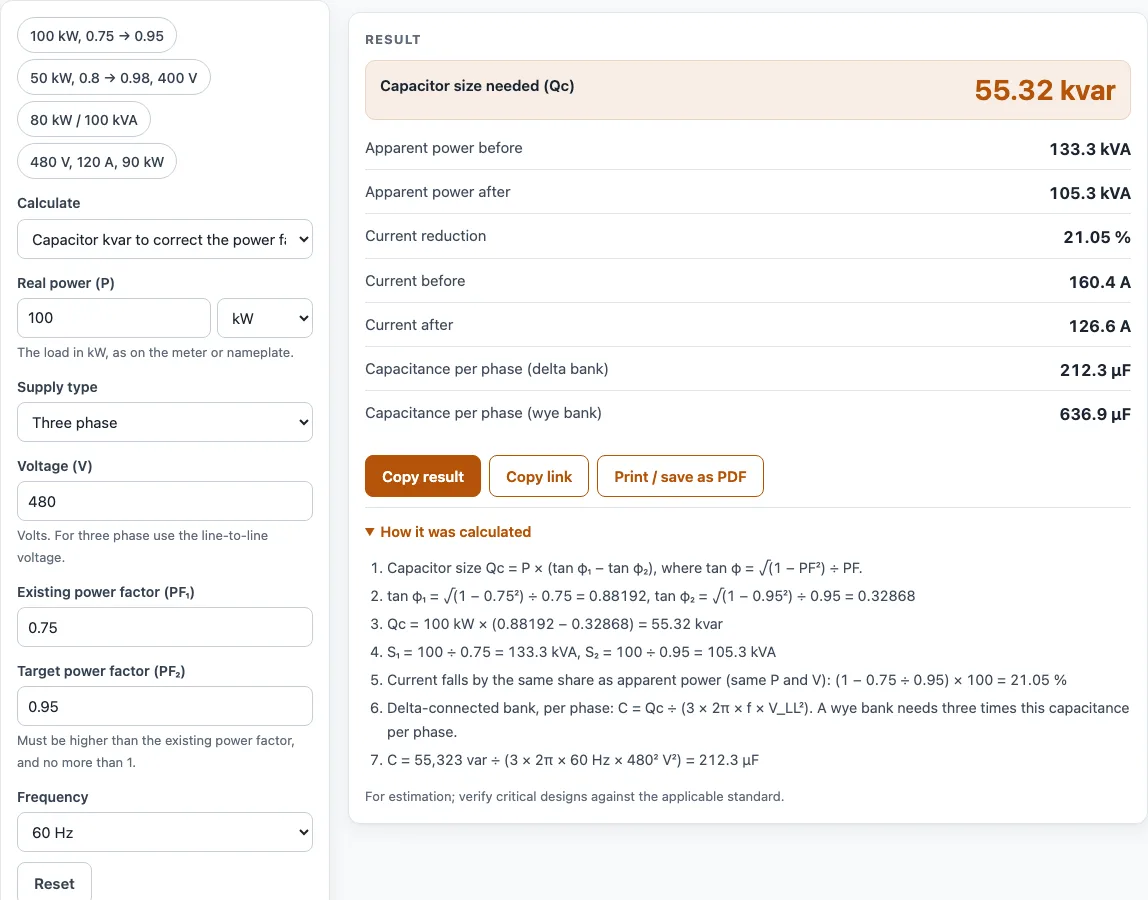
How to use the Power factor calculator
- Open the Calculate drop-down and choose a mode: Capacitor kvar to correct the power factor, Power factor from measurements, or Phase angle and power factor.
- For capacitor correction, enter the Real power (P) and pick its unit (kW, W or MW). Set Supply type to Three phase or Single phase.
- Enter the Voltage (V). For three phase, use the line-to-line voltage.
- Enter the Existing power factor (PF₁) and the Target power factor (PF₂). The target must be higher than the existing value and no more than 1.
- Choose the Frequency, 60 Hz or 50 Hz.
- For measurements, open the I know drop-down and pick kW and kVA, or kW, voltage and current. Then fill in the matching fields, including Line current (I) in amps.
- For phase angle, open I know and pick Power factor or Phase angle (degrees), then enter the value you have.
- Read the result rows. Only rows that apply to your mode appear.
The example buttons above the form load ready-made cases, such as 100 kW from 0.75 to 0.95. Copy link stores every input in the page address, so the same calculation reopens later. Print / save as PDF includes the inputs, results, steps and date. Reset returns to the starting example.
How do you calculate power factor?
Power factor is real power divided by apparent power: PF = kW ÷ kVA. It also equals cos φ, where φ is the phase angle between voltage and current. A PF of 1 means voltage and current are in step, so all the power does useful work.
When you have meter readings, use the direct formulas. For single phase, PF = kW × 1,000 ÷ (V × I). For three phase, PF = kW × 1,000 ÷ (√3 × V × I). Here kW is multiplied by 1,000 to get watts, V is volts and I is amps. For example, 90 kW at 480 V and 120 A on three phase gives about 0.90. If you know the phase angle instead, PF is its cosine: a 36.87° angle gives PF 0.8.
What is the formula for power factor correction?
The capacitor size is Qc = P × (tan φ1 − tan φ2), where P is real power in kW, φ1 is the angle for the existing power factor, and φ2 is the angle for the target. To use it, convert each power factor to an angle with cos⁻¹, take the tangent of each angle, subtract, and multiply by P.
Take 100 kW moving from PF 0.75 to 0.95. The existing angle is 41.41° (tan 0.882) and the target angle is 18.19° (tan 0.329). The difference of 0.553 times 100 gives 55.32 kvar. Apparent power falls from 133.3 kVA to 105.3 kVA, and the current drops by about 21 %.
Capacitance per phase depends on the bank type. For a delta-connected three-phase bank, C = Qc ÷ (3 × 2π f × V_LL²). For a single-phase bank, C = Qc ÷ (2π f V²). The calculator shows the result for the bank types that apply to your inputs. Do not aim above unity, because over-correction produces a leading power factor. Each step closer to 1 needs more capacitance for the same gain, which the kvar result shows.
Worked examples
| Input | Result |
|---|---|
| 100 kW, PF 0.75 → 0.95, 480 V, 60 Hz | 55.32 kvar |
| 50 kW, PF 0.8 → 0.98, 400 V, 50 Hz | 27.35 kvar |
| 80 kW, 100 kVA | PF 0.8 |
| 90 kW, 480 V, 120 A | PF 0.9021 |
| PF 0.8 | φ = 36.87°, PF 0.8 |
Calculated by the tool above with these values.
Frequently asked questions
How do I calculate the capacitor kvar needed?
Use Qc = P × (tan φ1 − tan φ2), with P in kW and φ1 and φ2 from the existing and target power factors. Select Capacitor kvar to correct the power factor in the calculator, enter P, voltage, supply type, PF₁ and PF₂, and the steps appear in “How it was calculated.”
What is a good power factor?
The calculator warns when a power factor below 0.5 is entered, because that is unusually low for a real load. The closer the value is to 1, the less current the load draws for the same useful power. Many utilities charge for low power factor, so check your own tariff.
Why must the target power factor be higher than the existing one?
Correction adds capacitance to raise the power factor, so a target at or below the existing value needs no added kvar. The target also cannot exceed 1.
Does correcting power factor lower my costs?
Correcting power factor lowers current, losses and kVA demand. Whether your bill changes depends on how your utility charges for low power factor, so confirm this with them before you size equipment.
Can I use the results in a quote or report?
Yes. Results may be used freely in commercial work such as quotes, proposals, reports and service records, and no attribution is needed. Verify critical designs against the applicable standard before you rely on them.
What does the capacitance per phase result show?
It gives the capacitance each phase of the bank needs, using the formula for delta or single-phase banks shown above. Use it as a starting figure, then confirm the final bank rating with the supplier and the applicable standard.
Related tools
- kVA to kW calculator: convert apparent power to real power when you know the power factor.
- Three phase power calculator: find kW, kVA and current for a three-phase supply.
- kVA calculator: work out apparent power from voltage and current.
- kW to amps calculator: estimate the current a load draws from its kW rating.
- Transformer sizing calculator: choose a transformer rating for a known load.
- Ohm’s law calculator: solve for voltage, current or resistance in a circuit.
- All electrical calculators: browse every electrical tool on the site.
Sources
- OpenStax University Physics Vol. 2, §15.4 Power in an AC circuit: real power and power factor