Ohm's Law Calculator (Ohms Law)
Enter any two of voltage, current, resistance and power; the calculator gives the other two and shows the formula used.
This ohms law calculator finds voltage, current, resistance and power when you know any two of them. Pick the pair of values you have, enter them, and the tool works out the other two using V = I × R and the power formulas. It is useful for DC circuits and resistive loads, such as a heater element or a resistor in a simple circuit.
The calculator runs in your browser, is free, and needs no sign-up. Nothing you enter is uploaded. You can use it as an ohm calculator for a single resistor or as a quick check on a heater’s current draw.
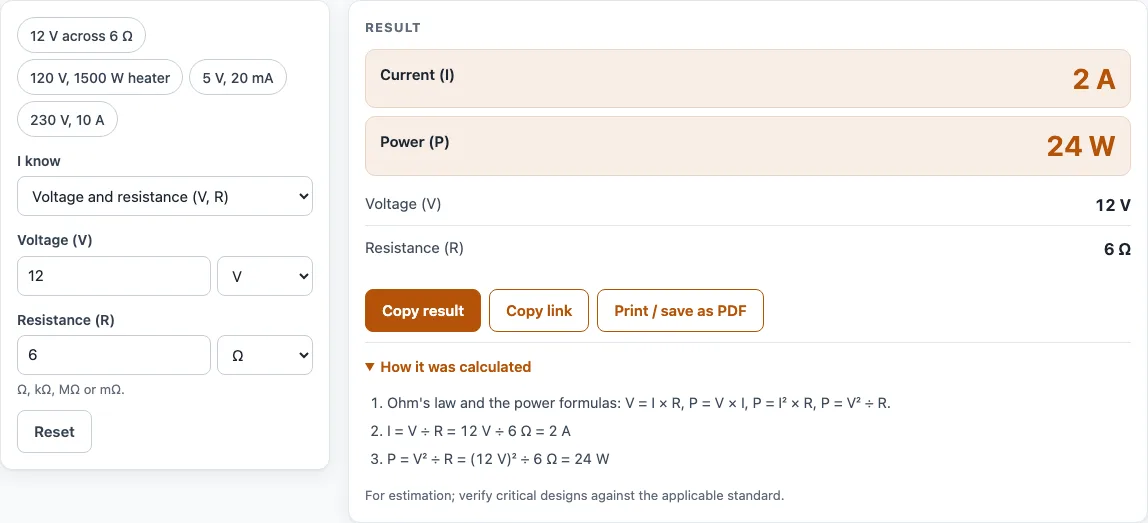
How to use the Ohm’s law calculator
- Open the “I know” drop-down and choose the pair you have, such as Voltage and current (V, I) or Current and resistance (I, R).
- Type the first known value and select its unit. Voltage accepts V, mV or kV. Current accepts A or mA. Resistance accepts Ω, kΩ, MΩ or mΩ. Power accepts W, mW or kW.
- Type the second known value and select its unit. You can mix units, for example volts with milliamps; the calculator converts them before it applies the formula.
- Read the result rows, which list all four quantities. Only the rows that apply to your chosen mode appear, showing voltage (V), current (I), resistance (R) or power (P).
- Check any warning that appears, then open “How it was calculated” to see the formula and each step with your own numbers.
To start quickly, press one of the example buttons: 12 V across 6 Ω, 120 V, 1500 W heater, 5 V, 20 mA, 230 V or 10 A. Copy result copies the result lines and a link. Copy link saves every input in the page address, so the same calculation reopens later. Print / save as PDF gives the inputs, results, steps and date. Reset returns the form to the starting example.
What is the formula for Ohm’s law (the Ohm’s law equation)?
Ohm’s law states that voltage equals current multiplied by resistance: V = I × R. Voltage is measured in volts (V), current in amps (A) and resistance in ohms (Ω). If you know any two of these, you can find the third by rearranging the formula.
The two rearranged forms are I = V ÷ R, which gives current when you know voltage and resistance, and R = V ÷ I, which gives resistance when you know voltage and current.
How do you calculate resistance from voltage and current?
Divide the voltage by the current: R = V ÷ I. Make sure both values use base units first. For example, 20 mA must become 0.02 A before dividing.
Take 5 V and 20 mA. Convert 20 mA to 0.02 A, then calculate 5 ÷ 0.02 = 250 Ω. The calculator performs this conversion for you when you select the unit.
What is the relationship between voltage, current and resistance?
Voltage, current and resistance are linked so that changing one affects the others. For a fixed voltage, more resistance means less current. For a fixed resistance, more voltage pushes more current through the circuit.
This relationship only holds for resistive loads on DC. For AC loads with inductance or capacitance, impedance takes the place of resistance and the power factor matters.
How do you calculate power from voltage and resistance?
Use P = V² ÷ R. Square the voltage, then divide by the resistance. The result is in watts.
For 12 V across 6 Ω, the calculation is 12² ÷ 6 = 144 ÷ 6 = 24 W. The other power formulas are P = V × I and P = I² × R, and they give the same answer when the values are consistent with Ohm’s law.
How do the four quantities connect?
Any two of voltage, current, resistance and power are enough to find the other two. Once you have the missing values, you can check them with a second formula. For example, 120 V and 1500 W give a current of 12.5 A and a resistance of 9.6 Ω. Multiplying 120 V by 12.5 A returns 1500 W, which confirms the result.
Results above 1000 V, currents that are very high, or powers above 1 MW can indicate a unit mistake. The calculator shows a warning in these cases, so check your units first.
Worked examples
| Input | Result |
|---|---|
| V = 12 V, R = 6 Ω | I = 2 A, P = 24 W |
| V = 120 V, P = 1500 W | I = 12.5 A, R = 9.6 Ω |
| V = 5 V, I = 20 mA | R = 250 Ω, P = 0.1 W |
| V = 230 V, I = 10 A | R = 23 Ω, P = 2,300 W |
| I = 15 A, R = 8 Ω | V = 120 V, P = 1,800 W |
Calculated by the tool above with these values.
Frequently asked questions
Does Ohm’s law work for AC circuits?
Ohm’s law applies directly to resistive loads on DC. For AC loads with inductance or capacitance, the impedance replaces resistance, and the power factor affects the power.
Which units does the calculator accept?
Voltage accepts V, mV and kV. Current accepts A and mA. Resistance accepts Ω, kΩ, MΩ and mΩ. Power accepts W, mW and kW.
Why does the calculator show a warning?
A warning appears when a value looks unusual, such as a voltage above 1000 V, a very high current or a power above 1 MW. Warnings usually mean a unit was entered incorrectly, so check your inputs before using the result.
Can I use the results in a quote or report?
Yes. Results, charts and printouts can be used freely in commercial work such as quotes, proposals, reports and service records, and no attribution is needed. Each result carries the note “For estimation; verify critical designs against the applicable standard.”
Is my data sent anywhere?
No. The calculator runs entirely in your browser, and nothing is uploaded.
Do I need to create an account to use it?
No. The calculator is free and needs no sign-up or account of any kind.
Related tools
- Watts to amps calculator - Use it when you know the power and voltage and need the current in amps.
- Voltage drop calculator - Use it to check how much voltage is lost along a cable run.
- kW to amps calculator - Use it when your load is rated in kilowatts and you need the current.
- Power factor calculator - Use it for AC loads where the power factor changes the real power.
- DC wire size calculator - Use it to choose a wire gauge for a DC circuit.
- Three phase power calculator - Use it for power calculations on three-phase supplies.
- All electrical calculators - Use it to browse every calculator on the site.
Sources
- OpenStax University Physics Vol. 2, ch. 9: Ohm’s law and electrical power