kVA into kW Calculator (kVA to kW)
Enter kVA and power factor to get kW and kvar, or convert kW back to kVA.
The kVA to kW calculator converts apparent power in kilovolt-amperes (kVA) into real power in kilowatts (kW) using the power factor. To convert kVA into kW, multiply the kVA value by the power factor, and the tool can also run the reverse calculation, from kW back to kVA.
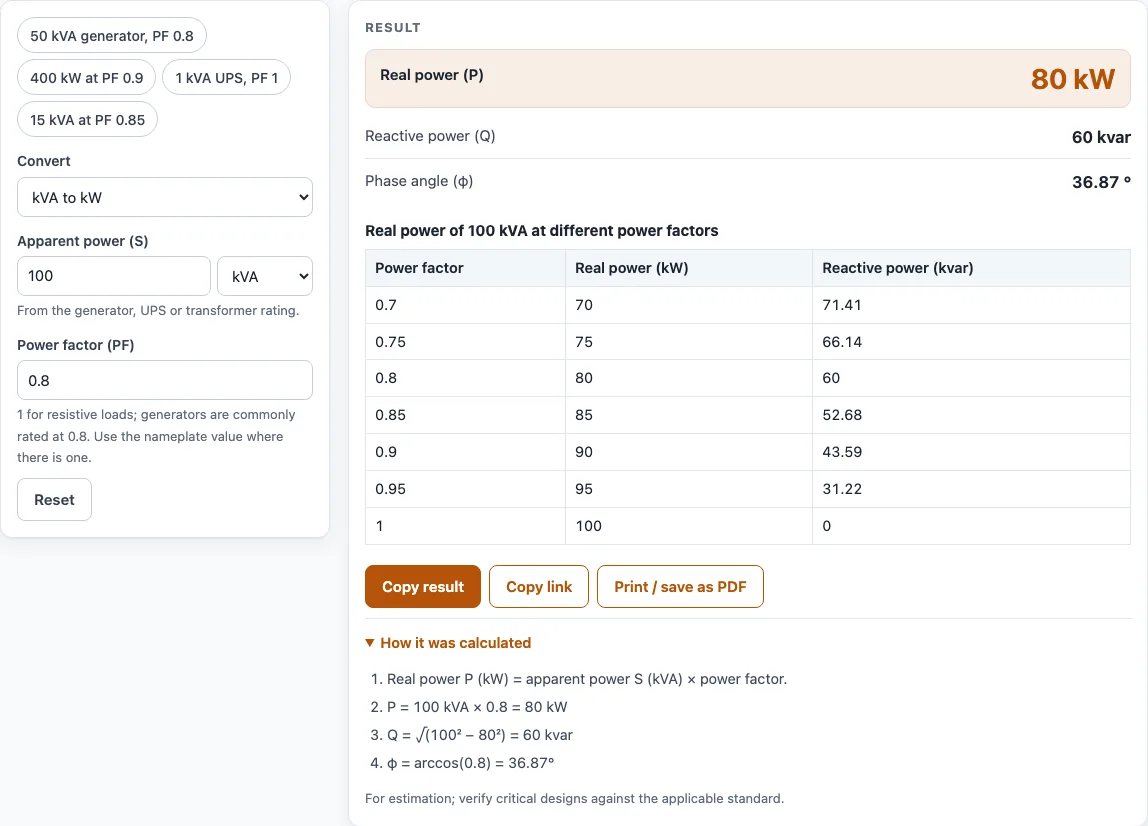
Enter a kVA rating and a power factor, and the calculator shows the real power in kW, along with the reactive power in kvar and the phase angle. It also builds tables of kW and kvar at power factors from 0.70 to 1.00, so you can see how the answer changes.
The calculator runs in your browser and is free to use. There is no sign-up, and nothing you enter is uploaded.
How to use the kVA to kW calculator
- Open the Convert drop-down and choose kVA to kW. The Apparent power (S) input is shown in this mode.
- Type the apparent power into Apparent power (S). Pick the unit from the list: kVA, VA or MVA.
- Type the power factor into Power factor (PF): 1 for a resistive load, the nameplate value for a motor or UPS, or 0.8 for a generator rating (generators are commonly rated at 0.8).
- Read the results. The Real power (P) row gives your answer in kW. The rows for apparent power, reactive power and phase angle are also shown.
- Scroll down to the tables to compare kW and kvar at nearby power factors.
- Check the How it was calculated section to see the formula and each step with your numbers.
To try the tool quickly, click one of the example buttons above the form, such as 50 kVA generator, PF 0.8. Use Reset to return to the starting example.
To keep a result, click Copy link. The page address stores every input, so the same calculation opens again later. Copy result gives the result lines with a link, and Print / save as PDF creates a printout with your inputs, results, steps and the date.
How do you convert kVA to kW?
To convert kVA to kW, multiply the kVA by the power factor: kW = kVA × PF. For example, a 50 kVA load at a power factor of 0.8 gives 50 × 0.8 = 40 kW.
The power factor is the ratio of real power (kW) to apparent power (kVA). It is 1 for purely resistive loads, such as heaters, and lower for motors and transformers. Because the power factor is never above 1, the kW value is always equal to or lower than the kVA value. To express the result in watts instead, multiply kVA by the power factor and by 1,000.
The calculator also finds the reactive power, which is measured in kvar. The formula is kvar = √(kVA² − kW²). For 100 kVA at a power factor of 0.8, the real power is 80 kW and the reactive power is 60 kvar.
How do you convert kW to kVA?
To convert kW to kVA, divide the kW by the power factor: kVA = kW ÷ PF. A load of 400 kW at a power factor of 0.9 needs 400 ÷ 0.9 = 444.4 kVA. A load of 80 kW at 0.8 needs 80 ÷ 0.8 = 100 kVA.
A lower power factor means you need a larger kVA rating for the same kW. This is why the kW-to-kVA result always comes out equal to or higher than the kW input. To compare several power factors at once, look at the tables under the result, which list kW and kvar for your kVA value at power factors from 0.70 to 1.00 in steps of 0.05.
Worked examples from the table
The table under the result shows the same kVA at several power factors, which is the quickest way to see what a load’s power factor costs you. For 100 kVA: 70 kW at PF 0.70, 80 kW at 0.80, 90 kW at 0.90 and 100 kW at 1.00, with the reactive power falling from 71.41 kvar to zero. For a generator rated 50 kVA at 0.8, that means 40 kW of real power; if your loads have a power factor of 0.9, the generator’s current limit, not its kW figure, decides how much you can connect.
Worked examples
| Input | Result |
|---|---|
| 50 kVA, PF 0.8 | 40 kW |
| 400 kW, PF 0.9 | 444.4 kVA |
| 1 kVA, PF 1 | 1 kW |
| 15 kVA, PF 0.85 | 12.75 kW |
| 80 kW, PF 0.8 | 100 kVA |
Calculated by the tool above with these values.
Frequently asked questions
How many kW is 1 kVA?
At a power factor of 1, 1 kVA equals 1 kW. At a power factor of 0.8, 1 kVA equals 0.8 kW. The exact value depends on the power factor of the load.
Why are generators rated in kVA?
A generator’s output is limited by the current and voltage it can supply, and these limits do not depend on the type of load connected. Generators are therefore rated in kVA. They are commonly rated at a power factor of 0.8, so a 50 kVA generator gives 40 kW.
How do you convert kVA into watts?
Multiply the kVA by the power factor and by 1,000. For example, 15 kVA at a power factor of 0.85 gives 15 × 0.85 × 1,000 = 12,750 W, which is 12.75 kW.
What does a low power factor warning mean?
The calculator shows a warning when the power factor you enter is below 0.5, which is unusual for a real load, so check the value you entered. If the value is correct, expect the kW result to be much lower than the kVA rating.
What is kvar?
Kvar is reactive power, the part of the apparent power that does not deliver real work. It is found with kvar = √(kVA² − kW²). The calculator shows this value in the result rows.
Related tools
- kVA calculator: use it when you need to find the apparent power from other electrical values.
- Power factor calculator: use it when you know the kW and kVA and need the power factor.
- Generator size calculator: use it when you are choosing a generator for a set load.
- kW to amps calculator: use it when you need the current drawn by a load in kW.
- Three phase power calculator: use it for power calculations on three-phase systems.
- Transformer sizing calculator: use it when you need to choose a transformer rating in kVA.
- All electrical calculators: use it to browse every calculator on the site.
Sources
- OpenStax University Physics Vol. 2, §15.4 Power in an AC circuit: real power and power factor
- Generac, Basic Sizing for Mobile Generators: 0.8 lagging power factor, 70–85 % loading