kVA Calculator (Amps to kVA)
Convert amps to kVA, or kVA to amps such as a transformer's full-load current, at any voltage.
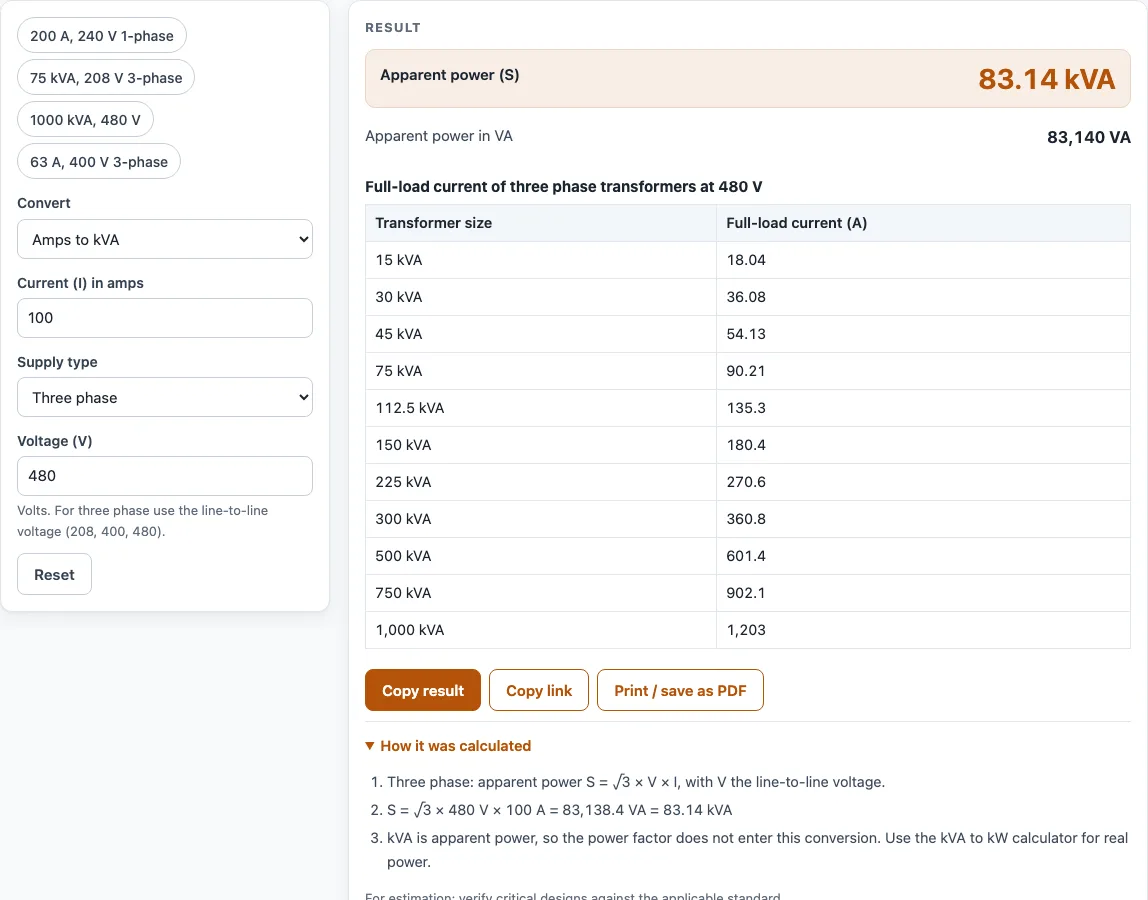
How to use the kVA calculator
- Open the Convert drop-down and choose Amps to kVA or kVA to amps (full-load current).
- Open the Supply type drop-down and choose Single phase or Three phase.
- Enter the Voltage (V) in volts. For three phase, use the line-to-line voltage, such as 208, 400 or 480.
- If the Current (I) in amps field is shown, type the current in amps.
- If the Apparent power (S) field is shown, type the kVA rating, for example from a transformer or generator nameplate, and choose the unit (kVA, VA or MVA).
- Read the result rows. Only the rows that apply to your chosen mode appear: Apparent power (S), Apparent power in VA and Current (I).
- Scroll to How it was calculated to see the formula with your own numbers in each step, and check the full-load current table for the standard transformer sizes at your voltage.
The example buttons above the form fill in sample values, such as 75 kVA at 208 V three phase. Copy result copies the result lines and a link. Copy link saves every input in the page address, so the same calculation reopens later. Print / save as PDF produces the inputs, results, steps and date. Reset restores the starting example.
How do you convert amps to kVA?
To convert amps to kVA on a single-phase supply, multiply the voltage by the current and divide by 1,000. On a three-phase supply, multiply the voltage by the current and by √3 (about 1.732), then divide by 1,000.
- Single phase: kVA = V × I ÷ 1,000
- Three phase: kVA = √3 × V × I ÷ 1,000
For example, 200 A at 240 V single phase gives 240 × 200 ÷ 1,000 = 48 kVA. For three phase, 100 A at 480 V gives √3 × 480 × 100 ÷ 1,000 = 83.14 kVA. The same formula works for 63 A at 400 V three phase, which gives 43.65 kVA.
How do you calculate kVA to amps?
To calculate amps from kVA on a single-phase supply, multiply the kVA by 1,000 and divide by the voltage. On a three-phase supply, divide by √3 times the voltage instead. This is how the full-load current of a transformer is found.
- Single phase: I = kVA × 1,000 ÷ V
- Three phase: I = kVA × 1,000 ÷ (√3 × V)
Take a 75 kVA transformer at 208 V three phase. The full-load current is 75 × 1,000 ÷ (1.732 × 208) = 208.2 A. A 1000 kVA transformer at 480 V three phase gives 1,000 × 1,000 ÷ (1.732 × 480) = 1,203 A, which is the same as converting 1000 kVA to amps at that voltage. Use the voltage that matches your supply, because the current changes in inverse proportion to it.
Reading the transformer tables
To convert amp to kVA for a transformer you already have, start from the full-load table instead: find the nameplate kVA and read the current at your voltage. For three phase at 480 V the table gives 90.21 A for 75 kVA, 180.4 A for 150 kVA and 601.4 A for 500 kVA. Going from ampere to kVA works the other way: a panel fed at 100 A, 480 V three phase is an 83.14 kVA load, which sits between the 75 and 112.5 kVA sizes. When you amp convert to kVA for sizing, remember that the transformer must also cover future load; the transformer sizing calculator adds a growth allowance and picks the standard size.
Worked examples
| Input | Result |
|---|---|
| 200 A, 240 V, single phase | 48 kVA |
| 75 kVA, 208 V, three phase | 208.2 A |
| 1000 kVA, 480 V, three phase | 1,203 A |
| 63 A, 400 V, three phase | 43.65 kVA |
| 100 A, 480 V, three phase | 83.14 kVA |
Calculated by the tool above with these values.
Frequently asked questions
What is the full-load current of a transformer?
The full-load current is the current the transformer carries when it delivers its full kVA rating at its rated voltage. It is found by dividing the kVA rating by the voltage, using the single-phase or three-phase formula. The tables under the result list these values for common sizes.
What is the difference between kVA and kW?
kVA is apparent power and kW is real power. kW equals kVA multiplied by the power factor (kW = kVA × PF), so kW depends on the power factor while kVA does not. Use kVA to size equipment such as transformers and generators, and kW to describe the power actually doing work.
Should I use line-to-line voltage for three phase?
Yes. For three-phase calculations, enter the line-to-line voltage, such as 208, 400 or 480 V. The √3 in the formula already accounts for the three phases, so entering a phase-to-neutral voltage gives a wrong result.
Why does the calculator show a voltage warning?
The warning “The voltage is very low” usually means the value was entered in kilovolts instead of volts. For example, 0.48 kV should be entered as 480 V. Check the voltage and try again.
Can I use the results in a quote or report?
Yes. Results, charts and printouts can be used freely in commercial work such as quotes, proposals, reports and service records, with no attribution needed. The note under each result says it is for estimation, so verify critical designs against the applicable standard.
Related tools
- kVA to kW calculator: use it to find real power in kW from a kVA rating when you know the power factor.
- Transformer sizing calculator: use it to choose a transformer size for a planned load.
- kW to amps calculator: use it to find the current when your load is given in kW.
- Three phase power calculator: use it to work out power for a balanced three-phase circuit.
- Fault current calculator: use it to estimate the short-circuit current at a point in a system.
- Watts to amps calculator: use it to convert a load in watts to current in amps.
- All electrical calculators: use it to browse the other tools on this site.
Sources
- OpenStax University Physics Vol. 2, §15.4 Power in an AC circuit: real power and power factor
- Schneider Electric FAQ FA91532: standard transformer kVA ratings (checked Oct 2026)