Generator Size Calculator
List the loads with their running and starting watts to get the generator size in kW and kVA.
The generator size calculator estimates the generator rating you need by adding the running watts of every load that runs at once, plus the extra starting watts of the largest motor. It runs in your browser, is free, and needs no sign-up. Nothing you enter is uploaded.
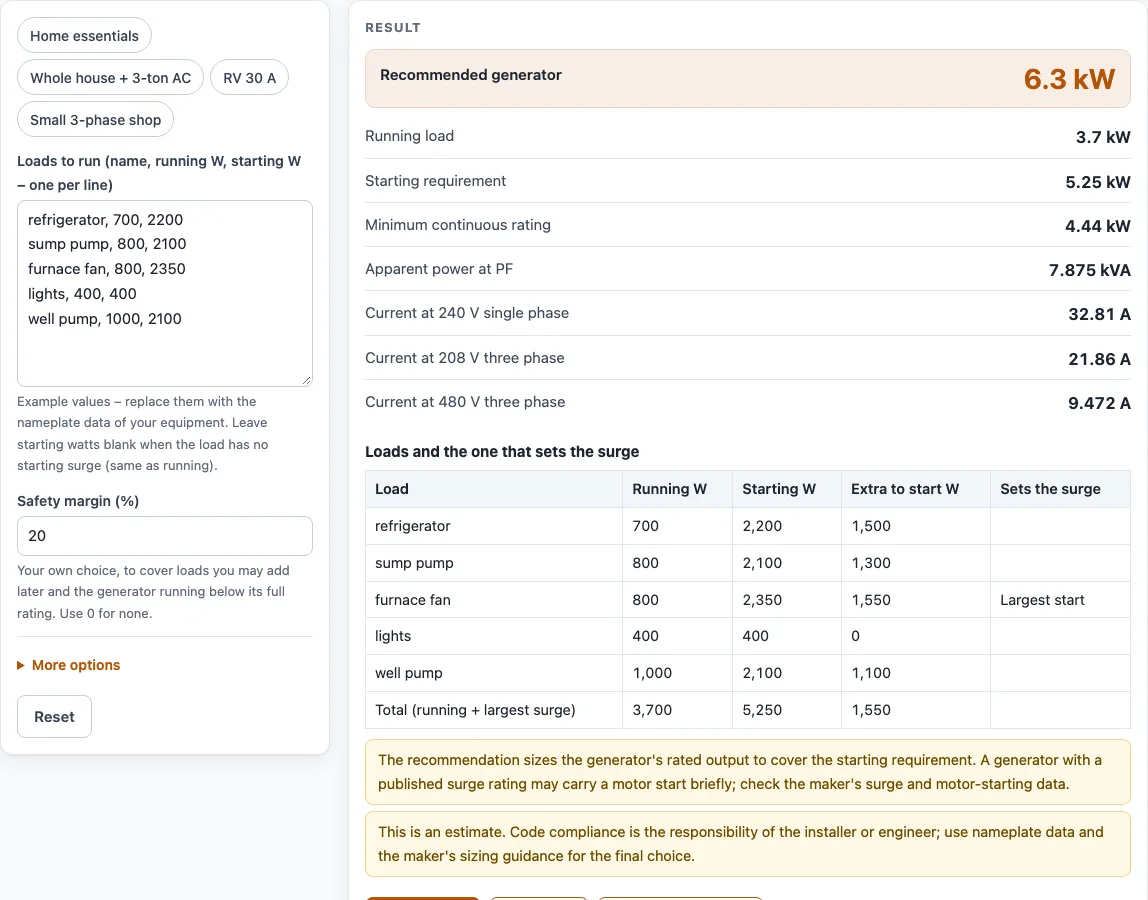
Enter your loads, set a safety margin, and the calculator shows the recommended generator size in kW, along with the running load, the starting requirement, and the currents at 240 V single phase, 208 V three phase and 480 V three phase where they apply. The method is shown step by step under the result, so you can check each figure against your own equipment. It works as an electric generator size calculator for home backup, a generator wattage calculator or wattage estimator for a list of tools, and a generator selection calculator when comparing two models.
How to use the Generator size calculator
- Click one of the example buttons above the form (Home essentials, Whole house + 3-ton AC, RV 30 A or Small 3-phase shop) to load a starting list, or keep the default list.
- In “Loads to run (name, running W, starting W – one per line)”, replace the example values with the nameplate data of your equipment. Put one load on each line.
- Enter starting watts for each motor, such as pumps, compressors and air conditioners. Leave starting watts blank for a load with no starting surge.
- Set “Safety margin (%)” to cover loads you may add later. Enter 0 for none.
- Open “More options”. Set “Generator power factor (PF)” to the figure from your generator’s data. The guide value is 0.8.
- If you are at altitude, enter “Site altitude” in ft or m. Then enter “Derating per 1,000 ft of altitude (%)” from the generator maker’s data sheet. Enter 0 for no derating.
- Read the result rows and any warning shown above them.
- Open “How it was calculated” to see every step with your own numbers.
Use “Copy result” to copy the result lines with a link, or “Copy link” to save every input in the page address. Use “Print / save as PDF” to keep the inputs, results, steps and date. “Reset” restores the starting example.
What size generator do I need?
Determining generator size starts with one rule: you need a generator whose rated output covers the running watts of everything that runs at the same time, plus the extra starting watts of the largest motor when it starts. The calculator adds these figures together and then applies your safety margin.
The method has three parts. First, the running total is the sum of the running watts of all loads. Second, the starting requirement is the running total plus the largest value of (starting watts minus running watts) for any one motor. The calculator assumes motors start one at a time. Third, the recommended generator is the starting requirement increased by your safety margin.
With the default list, the running load is 3.55 kW and the starting requirement is 4.65 kW. A 20 % margin gives a recommended size of 5.58 kW. The default watts are the upper ends of the ranges in Champion Power Equipment’s published wattage chart; replace them with your own nameplates. Generator kVA ratings use a nominal 0.8 lagging power factor (Generac’s sizing guide), so the apparent power row shows kVA as kW ÷ 0.8. For 5.58 kW, that is about 7.0 kVA.
What is the difference between running watts and starting watts?
Running watts are the power a load needs to keep operating. Starting watts are the higher power a load draws for a moment when it switches on. Motors, such as refrigerators, pumps, furnace blowers and air conditioners, draw several times their running power at start. Resistive loads, such as lights and heaters, do not have a starting surge, so their starting watts equal their running watts.
The starting figure matters because a generator sized only for running watts may struggle when a motor starts. If a load has starting watts below its running watts, the calculator uses the running watts as the starting figure and shows a warning.
The recommendation sizes the generator’s rated output to cover the starting requirement. A generator with a published surge rating may carry a motor start briefly, so check the maker’s surge and motor-starting data before you rely on a smaller unit.
Worked examples
| Input | Result |
|---|---|
| 5 loads, 20 % margin, PF 0.8 | Recommended 5.58 kW (running 3.55 kW, starting 4.65 kW) |
| 6 loads, 20 % margin, PF 0.8 | Recommended 11.46 kW (running 7.05 kW, starting 9.55 kW) |
| 4 loads, 20 % margin, PF 0.8 | Recommended 7.5 kW (running 4.25 kW, starting 6.25 kW) |
| 3 loads, 25 % margin, PF 0.8 | Recommended 17 kW (running 6.6 kW, starting 13.6 kW) |
Calculated by the tool above with these values.
Frequently asked questions
How many watts does a generator need to run a refrigerator?
The calculator does not use a fixed figure for refrigerators. Enter the running and starting watts from the refrigerator’s nameplate data as one line in the load list. Because a refrigerator is a motor, its starting watts are higher than its running watts, and that surge can set the starting requirement.
What size generator do I need for a whole house?
No single size fits every house. List each load you may run at the same time, using nameplate data, and enter starting watts for pumps, air conditioners and other motors. The calculator’s worked examples range from 5.58 kW to 17 kW, so the answer depends on your own list.
How do I calculate generator size?
Add the running watts of all loads that run together. Find the largest (starting minus running) value among your motors and add it to the running total. Then multiply that starting requirement by 1 plus your safety margin, for example 1.2 for a 20 % margin. The calculator shows each of these steps under “How it was calculated”.
Does altitude change the generator size I need?
Yes. Altitude and high temperature reduce a generator’s output. Enter the site altitude and the derating per 1,000 ft from the maker’s data sheet. The calculator then shows how much of the sea-level rating the generator delivers at your site.
Can this calculator size a three-phase generator?
Yes. The results include current at 208 V three phase and at 480 V three phase when they apply to the mode you choose. The “Small 3-phase shop” button loads an example list to start from.
Is the result enough for a permit or installation?
No. The result is an estimate. Code compliance is the responsibility of the installer or engineer. Verify critical designs against the applicable standard, and use the maker’s sizing guidance for the final choice.
Related tools
- Electrical load calculator: use it to total the loads on a circuit or panel before you size a generator.
- kVA to kW calculator: use it to convert a generator’s apparent power rating into real power in kW.
- Watts to amps calculator: use it to find the current a load draws at a given voltage.
- Transformer sizing calculator: use it when your system includes a transformer rated in kVA.
- Breaker size calculator: use it to choose a breaker that protects the circuit from a generator.
- Wire size calculator: use it to choose conductors for the generator’s output circuit.
- All electrical calculators: browse the full set of calculators on this site.
Sources
- Champion Power Equipment generator wattage chart: running and starting watts of the example loads (upper end of each range)
- Generac, Basic Sizing for Mobile Generators: 0.8 lagging power factor, 70–85 % loading