Electrical Load Calculator
Enter the floor area, appliances and heating or AC to get the calculated load in VA and amps and a service size.
The Electrical Load Calculator is a free residential electrical load calculator that estimates the total load of a home or other building in volt-amps (VA) and amps, then suggests a standard service size. For dwellings it follows the NEC 220.82 optional method, and a simple mode adds up connected loads and applies a demand factor you choose.
It runs in your browser, so nothing is uploaded, and there is no sign-up. Use it for a first estimate of a house’s service, a panel upgrade plan, or a quick check before a licensed electrician or engineer completes the formal load calculation.
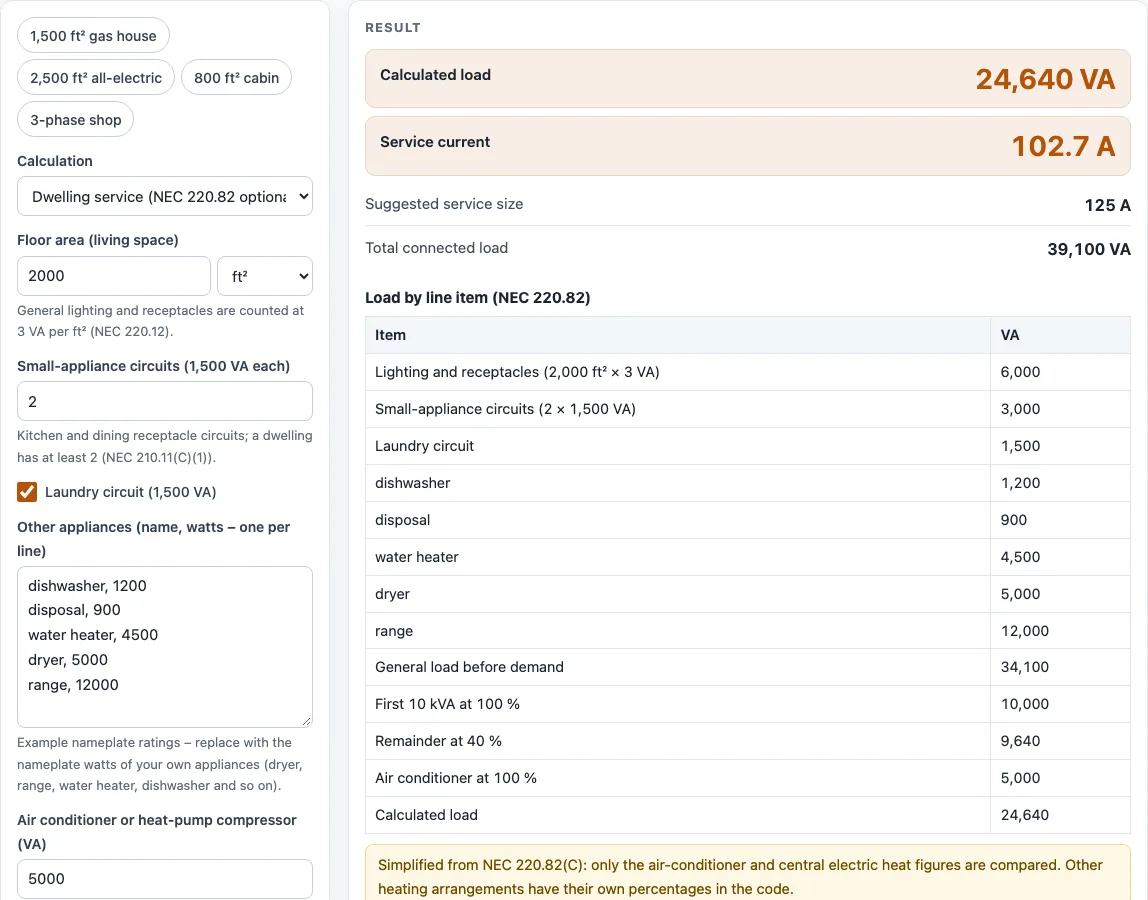
How to use the Electrical Load Calculator
- Open the Calculation drop-down. Choose Dwelling service (NEC 220.82 optional method) for a house, or the simple mode (connected load × demand factor) for other loads.
- Enter the Floor area (living space) in ft² or m².
- Set Small-appliance circuits (1,500 VA each). A dwelling has at least two.
- Tick Laundry circuit (1,500 VA) if the home has one.
- In Other appliances, type one appliance per line with its name and nameplate watts, such as range, dryer, water heater or dishwasher.
- Enter the nameplate VA for the Air conditioner or heat-pump compressor and for Central electric heating, if you have either.
- Open More options to set Service voltage (V) and Power factor (PF). Use 1 if your loads are given in VA.
- Read the results: Calculated load, Service current, Suggested service size and Total connected load. Only the rows for your mode appear. Check any warning shown.
- Scroll down to the Load by line item table and How it was calculated to check each step.
The example buttons above the form load starting points. Copy link saves every input in the page address, so the same calculation reopens later. Copy result and Print / save as PDF give you the result lines or a full printout with inputs, steps and the date. Reset restores the starting example.
How do you calculate the electrical load of a house?
Add up the expected load of the lighting, outlets, appliances and heating or cooling, convert the total to volt-amps (VA), and divide by the service voltage to get amps. For a house, the calculator starts from floor area and adds the nameplate ratings of your appliances.
Lighting and receptacles are counted at 3 VA per ft² (NEC 220.82(B)(1)). Each small-appliance circuit adds 1,500 VA, and a dwelling has at least two of them for the kitchen and dining area. The laundry circuit adds 1,500 VA. Fixed appliances such as a range, water heater, dryer or dishwasher count at their nameplate rating, not a guess.
Once the total VA is known, service amps equal VA ÷ 240 V. The suggested service is the next standard ampere rating of NEC 240.6(A) at or above that current, never below the 100 A minimum of NEC 230.79(C) for a one-family dwelling. For example, a 2,000 ft² house with the default appliance list comes to 24,280 VA, which is 101.2 A, so the minimum standard rating is 110 A. Service panels and meter sockets are sold in fewer sizes, so in practice you pick the next size your utility and panel maker offer, such as 125 A.
What is the NEC optional method for load calculation?
The NEC optional method, in NEC 220.82, is a simpler way to size a dwelling’s service than adding every circuit one by one. It takes general loads at 100 % for the first 10 kVA and 40 % for the remainder. Fixed appliances and the other loads are then added to that figure.
Heating and cooling are added separately. The calculator counts the larger of 100 % of the air-conditioning load or 65 % of central electric heat. This is a simplified form of NEC 220.82(C), which compares only those two figures. Other heating arrangements have their own percentages in the code, so check them with the code book or a licensed professional.
The method is designed for a whole dwelling’s service, and the line-item table keeps your electrical load calcs readable for an inspector or a client. It does not replace the detailed calculation needed for commercial buildings or unusual loads.
Worked examples
| Input | Result |
|---|---|
| 2000 ft² dwelling, example appliance list | 24,280 VA = 101.2 A, suggested service 110 A |
| 1500 ft² dwelling, example appliance list | 13,680 VA = 57 A, suggested service 100 A |
| 2500 ft² dwelling, example appliance list | 26,380 VA = 109.9 A, suggested service 110 A |
| 800 ft² dwelling, example appliance list | 18,010 VA = 75.04 A, suggested service 100 A |
| 41,000 W connected, 80 % demand, 480 V | 36,440 VA = 43.84 A |
Calculated by the tool above with these values.
Frequently asked questions
What size electrical service do I need?
The calculator suggests the next NEC 240.6(A) standard rating at or above your calculated amps, from 100 A (the NEC 230.79(C) minimum for a one-family dwelling) up to 400 A. Panels come in fewer sizes, so round up to one you can buy. The serving utility and the authority having jurisdiction make the final decision on size.
How many amps does a house need?
Divide the calculated load in VA by 240 V. The 2,000 ft² example house comes to 24,280 VA, which is 101.2 A.
What does the demand factor mean?
In simple mode, the demand factor is the share of the connected load you expect to run at the same time. It is your own choice, so set it based on how the loads will actually operate. A value above 100 % counts more than the connected load, so check it if you see that warning.
Why does the result say it is only an estimate?
The appliance values in the example are placeholders until you replace them with the nameplate watts of your own equipment. Code compliance is the responsibility of the installer or engineer, and the local code edition applies.
What if my load is above 400 A?
The calculator stops at 400 A, the largest size it suggests. A larger service needs an engineered load calculation.
Can I use the results in a quote or report?
Yes. Results, charts and printouts can be used freely in commercial work such as quotes, proposals, reports and service records, with no attribution needed.
Related tools
- Breaker size calculator: use it to choose a breaker for a single circuit once you know the current it must carry.
- Generator size calculator: use it to estimate the generator capacity needed to run your loads during an outage.
- Watts to amps calculator: use it to convert a load in watts to amps at a given voltage and power factor.
- Wire size calculator: use it to pick a conductor size for a circuit that carries a known current.
- Transformer sizing calculator: use it to size a transformer for a known connected load.
- Voltage drop calculator: use it to check how much voltage a long run of wire loses at a given current.
- All electrical calculators: use it to browse every calculator on the site in one place.
Sources
- NFPA 70, National Electrical Code (free online access): sections cited on this page; no tables are reproduced
- EC&M: dwelling load calculations per the NEC: NEC 220.82 optional method
- Virginia Tech Extension BSE-301: typical appliance wattages used for the example list