DC Wire Size Calculator (12V, 24V, 48V)
Enter the system voltage, current and one-way length to get the wire gauge for your allowed voltage drop.
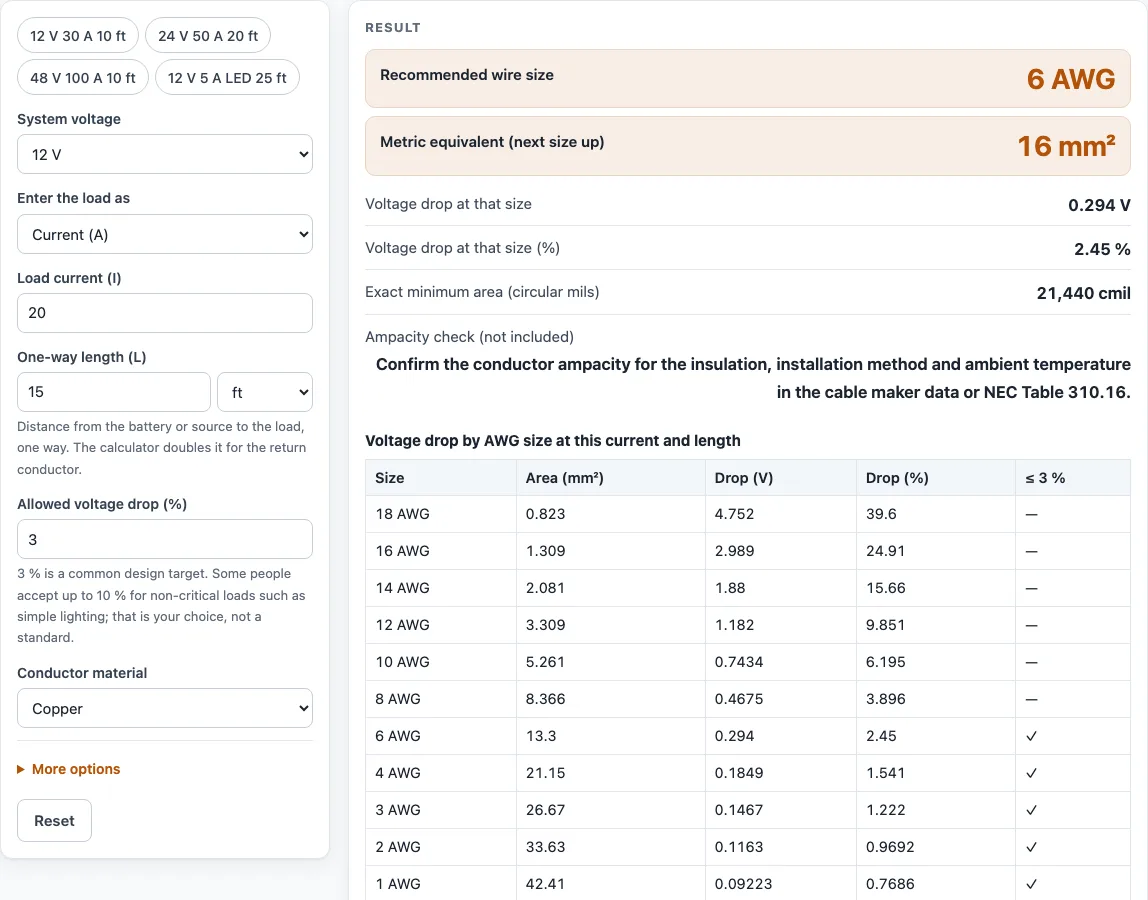
How to use the DC wire size calculator
- Choose a System voltage from the drop-down: 12 V, 24 V, 36 V, 48 V, or Other voltage. If you pick Other voltage, type your voltage in the System voltage (V) field that appears.
- Set Enter the load as to Current (A) or Load power (W or kW).
- Type the Load current (I) or the Load power in the field that appears for your choice.
- Enter the One-way length (L), measured from the battery or source to the load. The calculator doubles it for the return conductor.
- Set the Allowed voltage drop (%). 3 % is the limit ABYC E-11 sets for critical circuits on boats.
- Choose Conductor material: Copper or Aluminum.
- Open More options to set the Conductor temperature (20 °C, 60 °C, 75 °C or 90 °C). Tick Stranded conductor if your wire is stranded.
- Read the results: Recommended wire size, Metric equivalent, Voltage drop at that size (in volts and %), and Exact minimum area (circular mils). The Ampacity check row reminds you to confirm the wire’s safe current yourself.
The example buttons above the form load preset calculations, such as 12 V 30 A 10 ft. The “How it was calculated” section below the result shows each step with your numbers. Copy result copies the result lines and a link. Copy link stores every input in the page address, so you can reopen the same calculation later. Print / save as PDF produces a file with inputs, results, steps and the date. Reset restores the starting example.
What size wire do I need for 12 volts?
For a 12 V system, the right wire size depends on three things: the current, the one-way length and the voltage drop you accept. Low-voltage DC circuits are usually sized by voltage drop, because a few volts lost in the cable is a large share of a 12 V supply.
Take 12 V, 20 A, 15 ft one way, with a 3 % limit. 8 AWG gives about 3.9 % drop, which is above the target, so the calculator recommends 6 AWG (16 mm²), which gives 2.45 %. A short 12 V, 5 A LED run of 25 ft needs 10 AWG (6 mm²) to stay at 2.58 %.
The allowed drop is your choice. On boats, ABYC E-11 uses 3 % for critical circuits such as navigation lights and electronics and 10 % for non-critical loads such as general lighting (Blue Sea Systems’ summary). Wire must also carry the current safely for its insulation and installation, which is a separate check from voltage drop.
How do you calculate DC wire size?
The calculator uses the DC voltage drop formula VD = 2 × L × I × R. Here L is the one-way length, I is the current in amps, and R is the resistance of the conductor for that length. The factor of 2 covers the return conductor.
To work backwards, first find the largest drop you accept: system voltage × allowed %. Then rearrange the formula to get the resistance you need, R = VD ÷ (2 × L × I). The calculator picks the smallest wire whose resistance is at or below that value. Stranded wire adds a 2 % lay allowance to resistance, and conductor temperature changes resistance, so both can move the result up a size.
Voltage level matters too. Doubling the system voltage halves the current for the same power, and it quarters the percentage drop for the same wire. For example, 48 V, 100 A, 10 ft with a 3 % limit needs only 6 AWG (16 mm²), giving 2.04 %. This is why larger systems use 24 V or 48 V.
Worked examples
| Input | Result |
|---|---|
| 12 V DC, 20 A, 15 ft one way, 3 % allowed | 6 AWG (16 mm²), 2.45 % drop |
| 12 V DC, 30 A, 10 ft one way, 3 % allowed | 6 AWG (16 mm²), 2.45 % drop |
| 24 V DC, 50 A, 20 ft one way, 3 % allowed | 4 AWG (25 mm²), 2.57 % drop |
| 48 V DC, 100 A, 10 ft one way, 3 % allowed | 6 AWG (16 mm²), 2.04 % drop |
| 12 V DC, 5 A, 25 ft one way, 3 % allowed | 10 AWG (6 mm²), 2.58 % drop |
Calculated by the tool above with these values.
Frequently asked questions
Why do 12 V systems need thick wire?
A 12 V supply has very little voltage to spare, so each volt lost in the cable is a large share of what reaches the load. Thicker wire has lower resistance, which keeps the drop small at the same current.
How far can I run 12 volt wire?
There is no single maximum distance. It depends on the current, the wire size and the drop you accept. Enter your length and current to see the drop for each size.
What if the calculator shows a warning that no wire size meets my limit?
It means no single conductor up to 1000 kcmil meets the limit. Use parallel conductors, a higher system voltage or a shorter run.
What does a warning about a high allowed drop mean?
Above 10 %, the load may not get enough voltage, especially at low battery state of charge. Between 3 % and 10 %, sensitive loads such as inverters, electronics and motors may cut out.
Can I size aluminum wire with this tool?
Yes. Select Aluminum under Conductor material. Results are still estimates, so verify critical designs against the applicable standard.
Does the calculator check ampacity?
No. The Ampacity check row in the result is a reminder only: confirm the safe current for your insulation and installation, using NEC 310.16 or the boat or vehicle wiring standard you work to.
Related tools
- Voltage drop calculator: Use it when you already know the wire size and want to check the drop on a run.
- Wire size calculator: Use it for general wire sizing outside the DC-specific voltage drop setup.
- Ohm’s law calculator: Use it to work out voltage, current or resistance when two of them are known.
- Watts to amps calculator: Use it to convert a load’s power rating into current before entering it here.
- Cable size calculator: Use it when you are choosing cable size for a different installation.
- All electrical calculators: Use it to browse every calculator on the site.
Sources
- NBS Handbook 100, Copper Wire Tables: copper resistivity 0.017241 Ω·mm²/m, temperature coefficient 0.00393/°C, AWG sizes, stranding allowance
- NBS Handbook 109, Aluminum Wire Tables, Table 1: EC aluminium 0.028264 Ω·mm²/m, 0.00403/°C
- Blue Sea Systems wire sizing chart: ABYC E-11 3 % critical / 10 % non-critical