Cable Size Calculator (mm²)
Enter the load, voltage and cable length to get the minimum cable size in mm² by voltage drop, with mV/A/m.
The cable size calculator finds the smallest IEC cable size, from 1.5 mm² up to 120 mm² and beyond, whose voltage drop stays within the limit you choose. Enter your supply type, voltage, load, cable length and conductor material, and it returns the minimum cross-section for that circuit.
The calculator runs in your browser, so nothing is uploaded. It is free and needs no sign-up. It sizes cables for single-phase or three-phase circuits in copper or aluminium. It checks voltage drop only, so you still need to confirm that the cable can carry the current for your installation method. Treat the results as an estimate and verify critical designs against the applicable standard.
How to use the cable size calculator
- Choose Supply: Single phase (230 V) or Three phase (400 V).
- Set Voltage (V). Use 230 for single phase and 400 (line-to-line) for three phase, or type your own value, such as 240, 415 or 380.
- In Enter the load as, pick Current (A) or Load power (W or kW).
- If you chose current, type Load current (I). If you chose power, type Load power in kW or W, then enter Power factor (cos φ).
- Enter Cable length (L) in m or ft. Use the one-way run from the supply to the load.
- Select Conductor material: Copper or Aluminium.
- Choose Maximum voltage drop: 5 %, 3 % (lighting), or Other value. If you pick Other value, type the limit in Maximum voltage drop (%).
- Select Conductor temperature: 70 °C (PVC insulation) or 90 °C (XLPE / EPR insulation).
- Under More options, tick Stranded conductor if the cable is stranded. This adds a 2 % lay allowance to the resistance.
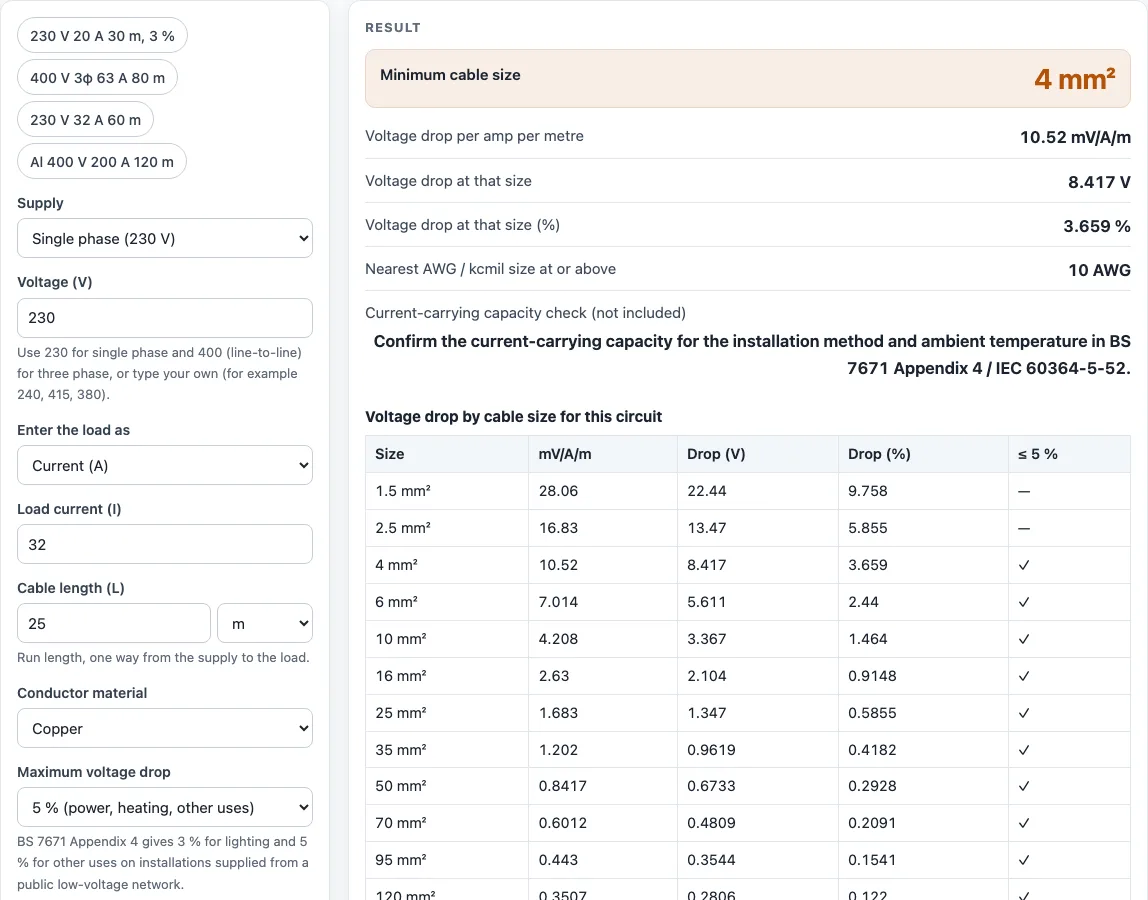
- Read the results: Minimum cable size, the voltage drop figures, and any warnings. The voltage drop table under the result shows how each size compares.
The example buttons above the form load preset circuits, such as 230 V, 20 A, 30 m at 3 %. Below the result, “How it was calculated” lists every step with your numbers. Use Copy result to copy the result lines with a link, or Copy link to save the page address, which stores all your inputs. Print / save as PDF produces a record with inputs, results, steps and the date. Reset returns to the starting example.
How do I calculate cable size?
The calculator finds the smallest cable whose voltage drop stays within your limit. It works out the drop for each IEC size using a resistive formula, then moves up the size list until the drop is acceptable. Longer runs and higher currents need larger cables, because both increase the drop.
For single-phase circuits, voltage drop is VD = mV/A/m × I × L ÷ 1,000, where I is the current in amps and L is the length in metres. Three-phase circuits use mV/A/m = √3 × R × 1,000 instead of the single-phase factor of 2 × R × 1,000, where R is the conductor resistance in Ω/m at its operating temperature. That temperature is 70 °C for PVC and 90 °C for XLPE.
As a worked example, take 230 V single phase, 32 A, 25 m of copper at 70 °C, with a 5 % limit. The calculator gives 4 mm², with a drop of 8.417 V (3.66 %). That is within the limit, while the next size down would not be a valid choice because it fails the check. The cable must also pass a current-carrying capacity check, which the calculator does not do.
What is mV/A/m?
mV/A/m is the voltage drop in millivolts for each amp of current carried over each metre of cable. It describes the cable itself, so it depends on the conductor’s resistance, which changes with material, cross-section and temperature. The result panel shows it as “Voltage drop per amp per metre.”
Once you know mV/A/m, the drop for a circuit is simply that value multiplied by current and length, divided by 1,000. Published cable tables usually give mV/A/m values a few percent higher than this resistive calculation. Use the cable maker’s figure for the final design. Aluminium has higher resistance than copper, so it needs a larger cross-section for the same voltage drop.
Using the table as a cable sizing chart
The table under the result works as a cable sizing chart for your circuit: every IEC size from 1.5 to 300 mm² with its mV/A/m and the drop it would give, so the cable selection is visible at a glance rather than hidden in a cable size calculation chart. Use it as a quick cable size calc for one circuit; the cable rating (its current-carrying capacity) and the cable dimension or width over the sheath come from the maker’s data, not from this cable selection calculator.
Worked examples
| Input | Result |
|---|---|
| Single phase (AC), 230 V, 32 A, 25 m, copper, 5 % limit | 4 mm² (8.417 V, 3.66 %) |
| Single phase (AC), 230 V, 20 A, 30 m, copper, 3 % limit | 4 mm² (6.312 V, 2.74 %) |
| Three phase (AC), 400 V, 63 A, 80 m, copper, 5 % limit | 10 mm² (18.37 V, 4.59 %) |
| Three phase (AC), 400 V, 32 A, 120 m, copper, 5 % limit | 10 mm² (13.99 V, 3.5 %) |
| Three phase (AC), 400 V, 200 A, 120 m, aluminum, 5 % limit | 95 mm² (15.16 V, 3.79 %) |
Calculated by the tool above with these values.
Frequently asked questions
What size cable do I need for 32 amps?
Current alone does not set the size. Voltage, run length, conductor material and the voltage drop limit all matter. For 230 V single phase, 32 A over 25 m of copper with a 5 % limit, the calculator gives 4 mm² (3.66 % drop); over 60 m the same circuit needs a larger cable. Check the current-carrying capacity for your installation method before fixing the size.
What is the maximum voltage drop allowed?
BS 7671 Appendix 4 gives a limit of 3 % for lighting and 5 % for other uses on installations supplied from a public low-voltage network. If you select Other value, the calculator warns you when the limit goes above 5 %, so check that the load can tolerate it.
How does cable length affect cable size?
A longer run has more resistance, so its voltage drop increases in proportion to its length. To keep the drop within the same limit, a longer run needs a larger cross-section. If no size in the list meets the limit, the calculator shows a warning and suggests parallel cables, a higher voltage or a shorter run.
Does the calculator check current-carrying capacity?
No. It sizes the cable for voltage drop only. Current-carrying capacity depends on the installation method, grouping and ambient temperature, and you can find those values in BS 7671 Appendix 4 or IEC 60364-5-52. The result list includes a row for this check, marked as not included.
Why does my cable maker’s table give a different value?
Published tables give mV/A/m values a few percent higher than this resistive calculation. The difference is expected, and the calculator is for estimation. For the final design, use the figure from the cable maker’s data.
Can I size aluminium cable with it?
Yes. Select Aluminium under Conductor material. Aluminium needs a larger cross-section than copper for the same voltage drop. For example, a 400 V three-phase circuit of 200 A over 120 m in aluminium at a 5 % limit gives 95 mm², with a drop of 3.79 %.
Related tools
- Voltage drop calculator: use it to check the voltage drop for a cable size you have already chosen.
- Wire size calculator: use it when you are sizing wire rather than a larger cable.
- DC wire size calculator: use it for direct-current circuits such as 12 V systems.
- kW to amps calculator: use it to convert a load in kilowatts into the current you enter here.
- Three phase power calculator: use it to work out power for a three-phase load before sizing its cable.
- Breaker size calculator: use it to pick a protective device rated for your cable.
- All electrical calculators: use it to browse every calculator on the site.
Sources
- NBS Handbook 100, Copper Wire Tables: copper resistivity 0.017241 Ω·mm²/m, temperature coefficient 0.00393/°C, AWG sizes, stranding allowance
- NBS Handbook 109, Aluminum Wire Tables, Table 1: EC aluminium 0.028264 Ω·mm²/m, 0.00403/°C
- IEC 60228 conductor sizes and resistances (summary)
- NICEIC on BS 7671 Appendix 4 voltage drop: 3 % lighting, 5 % other uses