Breaker Sizing Calculator
Enter the load or a motor's full-load current to get the minimum rating and the next standard breaker size.
Breaker sizing means choosing the breaker rating that protects a circuit at or above the minimum current the load requires. This breaker size calculator works that out for you: enter a load in amps or watts, tick continuous if it runs 3 hours or more, and it returns the minimum rating and the next standard breaker size. It also handles motor circuits, applying the NEC 430.52 maximum for the protective device you select.
Everything runs in your browser. Nothing is uploaded, there is no sign-up, and the tool is free.
The results are an estimate. Check them against the edition of the NEC adopted where you work before you install or buy anything.
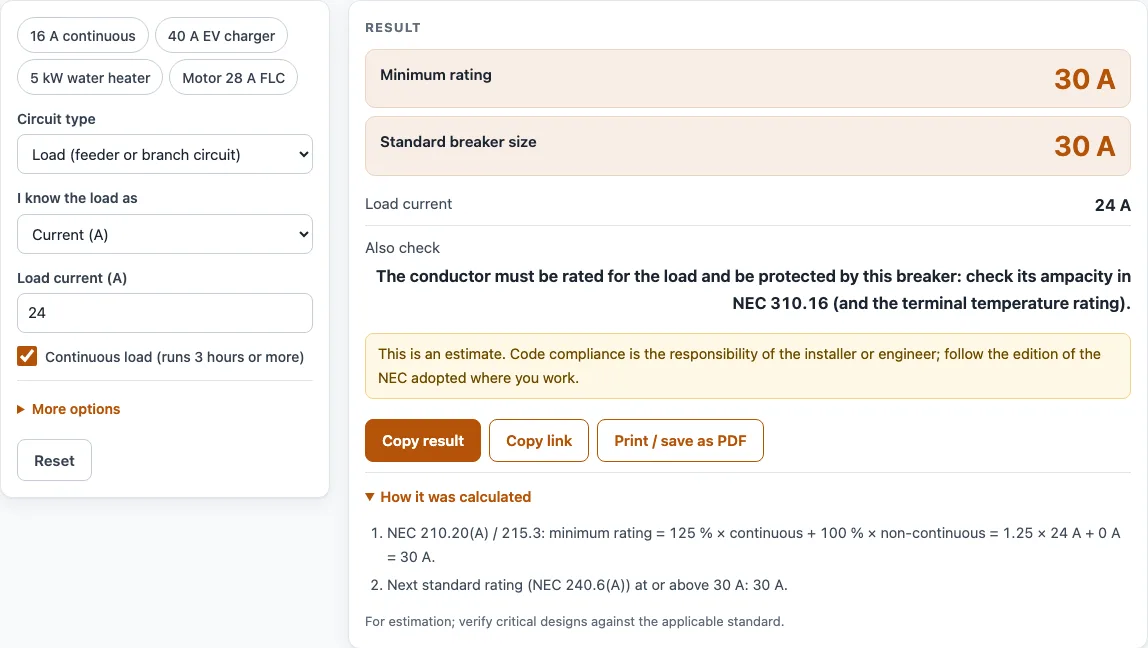
How to use the Breaker Size Calculator
- Choose Circuit type: Load (feeder or branch circuit) or Motor branch circuit.
- Under I know the load as, choose Current (A) or Power (W or kW). This option appears only in some modes.
- If you chose current, type the Load current (A). If you chose power, type the Load power (P) and pick W or kW.
- Enter the Voltage (V) and choose the Phase: Single phase or Three phase (line-to-line voltage).
- Enter the Power factor (PF). Use 1 for resistive loads such as heaters.
- Tick Continuous load (runs 3 hours or more) if the load runs that long.
- For a motor, type the Motor full-load current (A) from NEC Table 430.248 or 430.250, not the nameplate current. Then choose the Protective device.
- If the load has both a continuous and a non-continuous part, open More options and fill in Continuous part of the load (A) and Non-continuous part of the load (A). When either split field is filled, the main load fields are ignored.
- Read the result rows: Minimum rating, Maximum rating (NEC 430.52), Standard breaker size, Load current, and Also check. Read any warning shown.
The example buttons above the form load a sample calculation: 16 A continuous, 40 A EV charger, 5 kW water heater, or Motor 28 A FLC. Reset returns to the starting example.
Use Copy result to copy the result lines with a link, Copy link to save every input in the page address, or Print / save as PDF to get the inputs, results, steps and date.
How do you size a breaker?
Find the load current, multiply it by the NEC factor for that load type, and choose the next standard breaker rating at or above the result. The factor is 125 % for a continuous load and 100 % for a non-continuous load.
For a load with both parts, the minimum rating is:
Minimum = (1.25 × continuous current) + (1.00 × non-continuous current)
For example, a 24 A continuous load needs at least 24 × 1.25 = 30 A, so use a 30 A breaker. A 40 A EV charger on a continuous load needs 50 A, so use a 50 A breaker.
When the load is given in watts, convert it to current first. A 5 kW water heater at 240 V draws 5000 ÷ 240 = 20.83 A. Multiplied by 1.25, that is 26.04 A, so the breaker is 30 A. For a three-phase load, the calculator uses the line-to-line voltage, and the power factor is included in the current calculation.
A mixed load of 30 A continuous and 10 A non-continuous needs 30 × 1.25 = 37.5 A plus 10 A, which is 47.5 A. The next standard rating is 50 A.
What is the 125 % rule for breakers?
The 125 % rule says that an overcurrent device protecting a continuous load must be rated at least 125 % of that load’s current. NEC 210.20(A) and 215.3 apply it to loads that run 3 hours or more.
The extra 25 % gives margin for sustained heating in the breaker and the circuit, which a short-duration load does not produce. A load that runs for shorter periods only needs a breaker rated at 100 % of its current. If a load actually runs 3 hours or more and you sized it at 100 %, the breaker is undersized, so tick the continuous box in the calculator.
The rule sets the breaker, not the wire. The conductor must also be rated for the load and protected by the breaker. Check conductor ampacity in NEC 310.16, including the terminal temperature rating. Motor circuits follow different percentages in NEC 430.52, covered in the FAQ below.
Worked examples
| Input | Result |
|---|---|
| 24 A, continuous | Minimum 30 A, use a 30 A breaker |
| 40 A, continuous | Minimum 50 A, use a 50 A breaker |
| 5 kW at 240 V, continuous | Minimum 26.04 A, use a 30 A breaker |
| 30 A continuous + 10 A non-continuous | Minimum 47.5 A, use a 50 A breaker |
| Motor FLC 28 A, Inverse-time circuit breaker (250 %) | Maximum 70 A, next standard rating 70 A |
| Motor FLC 11 A, Dual-element time-delay fuse (175 %) | Maximum 19.25 A, next standard rating 20 A |
Calculated by the tool above with these values.
Frequently asked questions
How do you size a breaker for a motor?
Select Motor branch circuit, enter the full-load current from NEC Table 430.248 or 430.250, and choose the protective device. The calculator multiplies the full-load current by the NEC 430.52 percentage for that device: 250 % for an inverse-time breaker, 800 % for an instantaneous-trip breaker, 175 % for a dual-element time-delay fuse, or 300 % for a non-time-delay fuse. For a 28 A motor on an inverse-time breaker, the maximum is 70 A. For an 11 A motor on a dual-element fuse, the maximum is 19.25 A, so the next standard rating of 20 A is used.
What size breaker do I need for a continuous load?
Multiply the continuous current by 1.25, then round up to the next standard rating. A 24 A continuous load needs at least 30 A, so a 30 A breaker is the correct size. Tick the continuous box in the calculator so the 125 % factor is applied.
What are the standard breaker sizes?
Under NEC 240.6(A), the standard ratings are 15, 20, 25, 30, 35, 40, 45, 50, 60, 70, 80, 90, 100, 110, 125, 150, 175 and 200 A, and larger sizes above that. The calculator selects the next standard rating at or above the minimum it calculates.
Can the calculator size a three-phase breaker?
Yes. Choose Three phase (line-to-line voltage) under Phase and enter the line-to-line voltage. The calculator then uses the three-phase current formula with your power factor.
What does the warning about 6000 A mean?
It means the calculated minimum is above the largest standard rating in NEC 240.6(A), which is 6000 A. A size that large needs an engineered design, so the calculator does not give a standard breaker size for it.
Is the result enough to install a breaker?
No. The result is an estimate for planning. Code compliance is the responsibility of the installer or engineer, who must also check the conductor size and the other separate checks listed in the warnings.
Related tools
- Wire size calculator: Use it to choose the conductor that the breaker must protect.
- Electrical load calculator: Use it to add up several loads before choosing the feeder breaker.
- kW to amps calculator: Use it to convert a power rating to current before sizing the breaker.
- Watts to amps calculator: Use it when your load is listed in watts and you need the current quickly.
- Voltage drop calculator: Use it to check that the wire run keeps voltage within acceptable limits.
- Fault current calculator: Use it to check the available fault current at the breaker location.
- All electrical calculators: Use it to browse every calculator on the site.
Sources
- NFPA 70, National Electrical Code (free online access): sections cited on this page; no tables are reproduced
- ExpertCE on the 2023 NEC: 10 A added to the standard breaker ratings
- EC&M: instantaneous vs inverse-time breakers for motors: NEC 430.52 device percentages