AWG to mm2 Calculator (AWG to mm² and mm² to AWG)
Pick an AWG or kcmil size to get its area in mm², or enter mm² to find the nearest AWG.
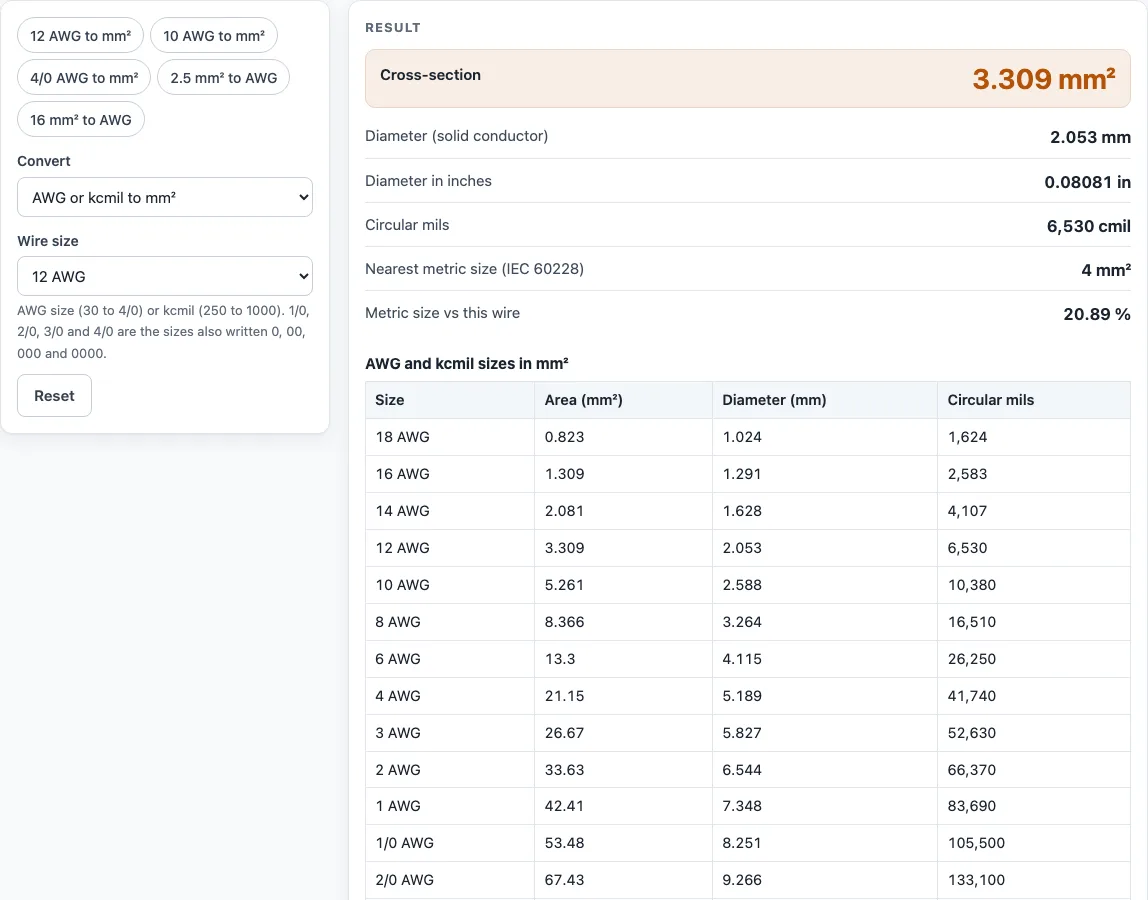
This AWG to mm2 calculator turns an American Wire Gauge size into its cross-sectional area in square millimetres (mm²). It also works in reverse: enter a cross-section in mm² and it returns the nearest AWG or kcmil size. For example, 12 AWG gives 3.309 mm², and 2.5 mm² gives 13 AWG. The results show the nominal copper cross-section of a size, along with its diameter, circular mils and the nearest metric cable size under IEC 60228. The converter does not calculate current capacity, voltage drop or resistance.
The calculator runs in your browser, is free and needs no sign-up, and nothing you enter is uploaded. A table under the result lists common sizes so you can compare them at a glance.
How to use the AWG to mm² Converter
- Open the Convert drop-down and choose either AWG or kcmil to mm² or mm² to AWG or kcmil.
- If you chose AWG or kcmil to mm², pick a size from the Wire size list. It runs from 30 AWG up to 4/0 AWG, then 250 to 1000 kcmil.
- If you chose mm² to AWG or kcmil, type the cross-section into Cross-section (mm²), for example 2.5 or 16.
- Read the result rows. Only the rows that apply to your mode are shown.
- Check any warning above the result. Then open How it was calculated to see the formula and each step with your numbers.
- To try the tool quickly, press one of the example buttons above the form: 12 AWG to mm², 10 AWG to mm², 4/0 AWG to mm², 2.5 mm² to AWG or 16 mm² to AWG.
Below the result, Copy result copies the result lines with a link, and Copy link saves every input in the page address so the same calculation reopens later. Print / save as PDF produces a copy with the inputs, results, steps and date. Reset returns the form to its starting example. The table under the result lists common AWG and kcmil sizes in mm², mm and circular mils.
How do you convert AWG to mm2?
To convert AWG to mm², find the wire diameter and then calculate the area of a circle with that diameter. The diameter of a solid conductor is d = 0.127 mm × 92^((36 − n)/39), where n is the gauge number, and the area is π/4 × d². For sizes written m/0, such as 1/0 or 4/0 AWG, use n = 1 − m, so 1/0 gives n = 0 and 4/0 gives n = −3.
For 12 AWG, n = 12, the diameter is 2.053 mm, and the area is 3.31 mm². You can also read the area directly from a published table, which is what the tool’s table does.
What is 12 AWG in mm2?
12 AWG is about 3.31 mm² in cross-section, with a solid diameter of 2.053 mm. The calculator returns 3.309 mm² when it works from the formula. Because 3.31 mm² falls between the metric sizes 2.5 mm² and 4 mm², the nearest metric size shown is 4 mm².
How do you convert mm2 to AWG?
Type the cross-section into Cross-section (mm²) and select mm² to AWG or kcmil. The tool compares your area with the area of every AWG and kcmil size, then shows the nearest size and how far off it is as a percentage. It also shows the next size at or above and the next size at or below your area, each with its own area.
For example, 2.5 mm² gives 13 AWG at 2.624 mm². The next size at or above is also 13 AWG, and the next size below is 14 AWG at 2.08 mm².
What is the difference between AWG and mm2?
AWG is a gauge system in which a higher number means a thinner wire. mm² is a metric unit of area, so it states the cross-section directly. Each AWG size changes the area by a factor of about 1.26, so every three sizes the area doubles.
Because the two systems do not line up exactly, a conversion gives the nearest size rather than an identical one. This is why the tool reports the nearest size along with its neighbours.
What is a kcmil?
A kcmil is a unit of wire size equal to 1,000 circular mils. One kcmil equals 0.5067075 mm², so 1000 kcmil is about 506.7 mm². It is used for larger conductors, and the tool’s list runs from 250 kcmil to 1000 kcmil.
Worked examples
| Input | Result |
|---|---|
| 12 AWG | 3.309 mm² |
| 10 AWG | 5.261 mm² |
| 4/0 AWG | 107.2 mm² |
| 2.5 mm² | 13 AWG (2.624 mm²) |
| 16 mm² | 5 AWG (16.77 mm²) |
Calculated by the tool above with these values.
Frequently asked questions
Does the converter tell me how much current a wire can carry?
No. The converter gives only the nominal copper cross-section of a size. Check the ampacity in the applicable code, because this page does not calculate it.
Why does 2.5 mm² show 13 AWG when the areas are not equal?
AWG sizes come in fixed steps, and 2.5 mm² falls between 14 AWG (2.08 mm²) and 13 AWG (2.624 mm²). The tool shows the nearest size and both neighbours so you can see the gap before you choose.
What does the warning about very fine wire mean?
The warning “Very fine wire: check the size and the unit” appears when the chosen wire has less than 0.1 mm² of cross-section, which is 28 AWG and finer. It is a reminder to confirm the size you picked. A different warning appears in mm² to AWG mode if your area is outside the 30 AWG to 1000 kcmil range of the list, because then the nearest size is only the end of the list.
Can I use the results in a quote or report?
Yes. Results, charts and printouts may be used freely in commercial work such as quotes, proposals, reports and service records. No attribution is needed. The note under every result says “For estimation; verify critical designs against the applicable standard.” Yes. Results, charts and printouts may be used freely in commercial work such as quotes, proposals, reports and service records, and no attribution is needed. The note under every result says “For estimation; verify critical designs against the applicable standard.”
Is my data uploaded anywhere?
No. Everything runs in your browser and nothing is uploaded. The tool is free and needs no sign-up.
Related tools
- Wire size calculator: use it when you need to choose a wire size for a circuit.
- Wire resistance calculator: use it when you need the resistance of a conductor.
- Cable size calculator: use it when you are choosing a cable by its metric cross-section.
- Voltage drop calculator: use it when you need to check voltage drop along a run.
- DC wire size calculator: use it when you are sizing wire for a DC circuit.
- All electrical calculators: use it to browse every electrical calculator on the site.
Sources
- NBS Handbook 100, Copper Wire Tables: the American Wire Gauge diameter formula
- American wire gauge (Wikipedia): published diameter and area values used to check the results (for example 12 AWG 2.053 mm and 3.31 mm²)
- IEC 60228 conductor sizes: the standard metric cross-sections