Watts to Amps Calculator (W to Amps)
Enter the power, voltage and circuit type to get the current in amps, or work back from amps to watts.
Popular tools
- Voltage Drop CalculatorEnter the circuit, the wire size and the one-way length to get the voltage drop in volts and percent, with every step.
- Power Factor Calculation and CorrectionFind the power factor of a load, or the capacitor size needed to raise it to a target value.
- Electrical Load CalculatorEnter the floor area, appliances and heating or AC to get the calculated load in VA and amps and a service size.
This free watts to amps calculator converts watts into amps by dividing power by voltage, with a power factor correction for AC loads such as motors. For example, a 1,500 W heater on 120 V draws 12.5 A.
The calculator runs in your browser with no sign-up. Enter the power, voltage, supply type and, when it applies, the power factor, and it shows the current in amps along with power, kilowatts and apparent power. Use it to check how much current a heater, motor or appliance draws before you choose a wire size or breaker. It also works the other way, as a calculator from watt to ampere and back, with the steps written out for a quote or a service record.
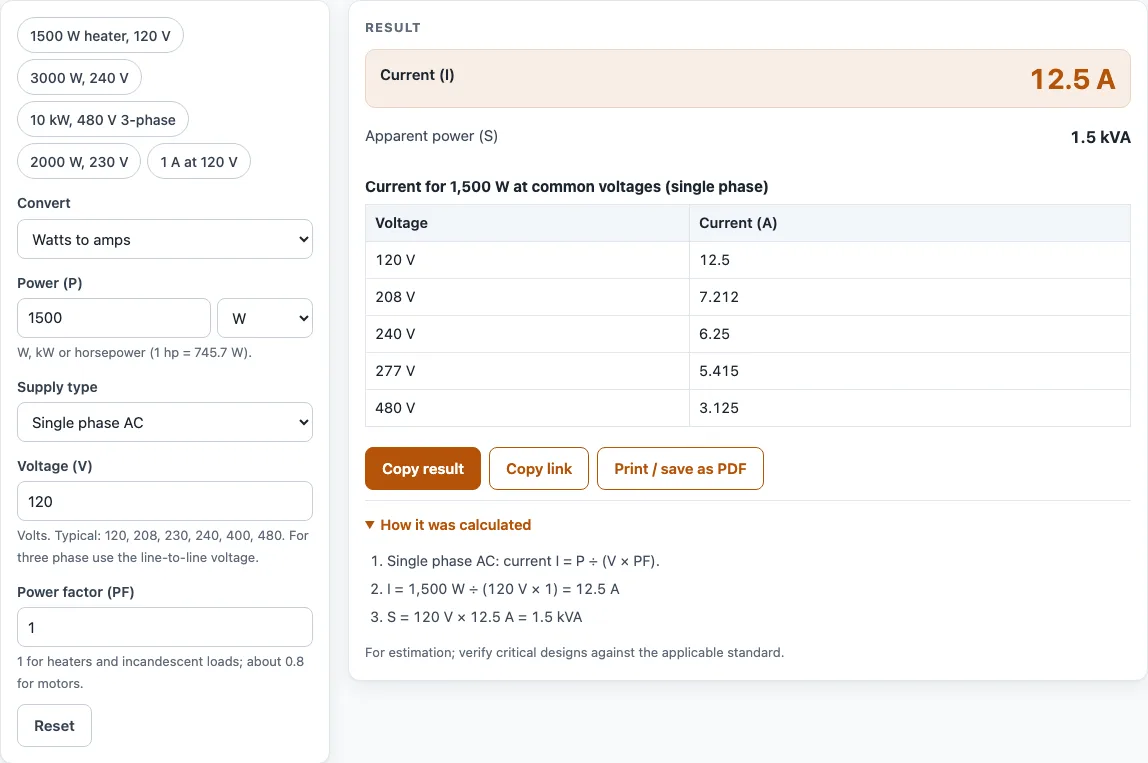
How to use the watts to amps calculator
- Open the Convert drop-down and choose Watts to amps.
- Enter the power in the Power (P) field and select the unit: W, kW or hp. One horsepower is 745.7 W.
- Choose a Supply type: Single phase AC, Three phase AC or DC.
- Type the Voltage (V). For three phase, use the line-to-line voltage. Typical values include 120, 208, 230, 240, 400 and 480.
- If the Power factor (PF) field appears, enter it. Use 1 for heaters and incandescent loads, and about 0.8 for motors.
- Read the result rows. Current (I) is your answer in amps. Power (P), Power in kilowatts and Apparent power (S) also appear when they apply to your mode.
- Open How it was calculated to see the formula and each step with your numbers.
The example buttons above the form load preset cases, such as a 1500 W heater on 120 V, so you can see a worked result straight away. The tables under the result show the current for your wattage at common voltages. Copy link stores every input in the page address, so the same calculation reopens later. Copy result gives the result lines plus a link, and Print / save as PDF includes inputs, results, steps and the date. Reset restores the starting example.
How do you convert watts to amps?
Divide the watts by the volts. For a DC load or a resistive single-phase load, the formula is I = P ÷ V, where I is current in amps, P is power in watts and V is voltage. A 1,500 W heater on 120 V draws 12.5 A, and on 240 V it draws 6.25 A.
For AC loads, the formula adds the power factor (PF). Single-phase AC uses I = P ÷ (V × PF). Three-phase AC uses I = P ÷ (√3 × V × PF), where V is the line-to-line voltage. Resistive loads such as heaters have a PF of 1, so the PF step does nothing for them.
How many watts is 1 amp?
There is no fixed number of watts in one amp, because the voltage sets the value. One amp at 120 V is 120 W, and one amp at 230 V is 230 W, for a resistive load. Multiply the amps by the volts to get the watts.
How many amps is 1,500 watts?
It depends on the voltage. Convert 1,500 W to 1.5 kW if your unit is kilowatts, then divide by the voltage. At 120 V, 1,500 W draws 12.5 A. At 240 V, it draws 6.25 A. Higher voltage means lower current for the same power, which is why many large appliances run on 240 V.
What is the formula for amps, volts and watts?
The core relationship is P = V × I, where P is power in watts, V is volts and I is amps. Rearranged, it gives I = P ÷ V. Real AC loads add the power factor: P = V × I × PF for single phase, and P = √3 × V × I × PF for three phase.
Power factor matters because motors and many electronic loads have a PF below 1. They draw more current than watts ÷ volts suggests. Apparent power in VA (or kVA) is V × I, or √3 × V × I for three phase. Watts are the real power, which is lower than the apparent power when PF is below 1.
How do you convert amps to watts?
Multiply the volts by the amps. For DC and resistive loads, use P = V × I. For a 1 A load at 120 V, the result is 120 W, or 0.12 kW. For AC loads, multiply by the power factor too: single phase is P = V × I × PF, and three phase is P = √3 × V × I × PF.
Current from this calculation is useful for sizing. The NEC sizes continuous loads, meaning loads running 3 hours or more, at 125% of their current. Check the current before you pick the wire and breaker, and verify critical designs against the applicable standard.
Which formula answers which question?
The same three quantities answer every version of the question, so this page works as a watts to amps calc, an amp to watt conversion calculator and a general amp volt watt converter:
- To determine amps from watts (finding amps with watts and volts, or amperage from a nameplate), divide: I = P ÷ V. That is how you compute amps from watts and calculate amperage from watts and voltage on DC or resistive loads.
- To calculate watts from volts and amps, multiply: amp x volts = watts, P = V × I. The amps-to-watts mode does this, so it doubles as a volts to watts conversion calculator (a V to watts converter needs the current as well as the voltage).
- The conversion of watts to volts works the same way: V = P ÷ I.
- A watts to amp hours conversion needs time: amp hours = watts × hours ÷ volts, so 120 W for 5 hours from a 12 V battery is 50 Ah.
- The formula ampere volt watt triangle is only complete for AC once the power factor is included.
The table under the result is a short watts to amps conversion table for the voltages you are most likely to meet.
Worked examples
| Input | Result |
|---|---|
| 1500 W, 120 V, single phase, PF 1 | 12.5 A |
| 3000 W, 240 V, single phase, PF 1 | 12.5 A |
| 10 kW, 480 V, three phase, PF 0.9 | 13.36 A |
| 2000 W, 230 V, single phase, PF 1 | 8.696 A |
| 1 A, 120 V, single phase, PF 1 | 120 W (0.12 kW) |
Calculated by the tool above with these values.
Frequently asked questions
Why is the amp value higher than watts ÷ volts for my motor?
Motors and many electronic loads have a power factor below 1. Because the real power in watts is lower than the apparent power, the current is higher than the simple division suggests. Enter the power factor, often about 0.8 for motors, to get the correct result.
Do I need the power factor for a heater?
No. Heaters and incandescent loads are resistive, so their power factor is 1. Enter 1 if the field appears, and the result is watts ÷ volts for single phase.
What does three phase voltage mean in this calculator?
Use the line-to-line voltage, such as 208, 400 or 480 V. A 10 kW load at 480 V on three phase with PF 0.9 draws about 13.36 A.
What happens if the current is very high?
The calculator shows a warning when the current is very high. Check the power and voltage you entered. Higher currents often need several conductors or a higher voltage to reduce the load on each wire.
How many watts is 1 amp on a 12 V system?
At 12 V, 1 amp is 12 W for a resistive load. For example, 100 W at 12 V draws about 8.33 A, so you can use the watts to amps table on the result page for a quick look at other values.
Is the result exact enough for wire and breaker sizing?
The result is for estimation. The page notes that critical designs should be verified against the applicable standard. Check the rules that apply in your area before you install anything.
Is my data uploaded anywhere?
No. Everything runs in your browser and nothing is uploaded. There is no sign-up, and the calculator is free to use.
Related tools
- kW to amps calculator: Use it when your power is given in kilowatts and you want the current directly.
- kVA calculator: Use it to find apparent power when your load has a power factor below 1.
- Ohm’s law calculator: Use it to solve for voltage, current or resistance when you know two of them.
- Three phase power calculator: Use it for power and current calculations on three-phase systems.
- Breaker size calculator: Use it to choose a breaker rating after you know the load current.
- Wire size calculator: Use it to select a conductor size for the current your load draws.
- Power factor calculator: Use it to work out the power factor when you know the real and apparent power.
- Watts to volts conversion calculator: use it when you know the watts and the amps or ohms and need the voltage.
- All electrical calculators: Use it to browse every calculator on the site.
Sources
- OpenStax University Physics Vol. 2, §15.4 Power in an AC circuit: real power and power factor
- NIST SP 811: unit conversions (1 hp = 745.7 W)